


Page 289 - Encyclopedia of Aquarium and Pond Fish, 3rd Edition
P. 289
SPONGES AND ANEMONES    287


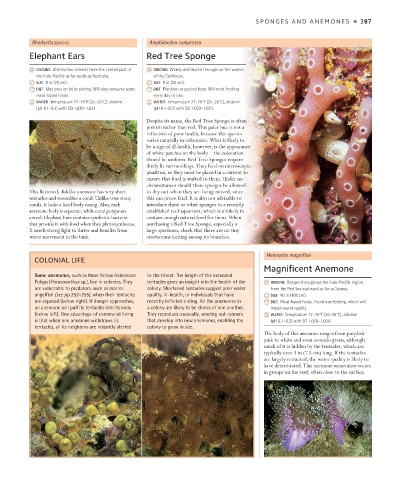
          Rhodactis species               Amphimedon compressa
         Elephant Ears                   Red Tree Sponge

           ORIGINS  Distribution extends from the central part of   ORIGINS  Widely distributed throughout the waters
           the Indo-Pacific as far south as Australia.  of the Caribbean.
           SIZE  8 in (20 cm).             SIZE  8 in (20 cm).
           DIET  May prey on brine shrimp. Will also consume some   DIET  Plankton or puréed food. Will need feeding
           meat-based foods.               every day or two.
           WATER  Temperature 77–79°F (25–26°C); alkaline    WATER  Temperature 77–79°F (25–26°C); alkaline
           (pH 8.1–8.3) with SG 1.020–1.024.  (pH 8.1–8.3) with SG 1.020–1.024.
                                         Despite its name, the Red Tree Sponge is often
                                         pinkish rather than red. This paler hue is not a
                                         reflection of poor health, because this species
                                         varies naturally in coloration. What is likely to
                                         be a sign of ill-health, however, is the appearance
                                         of white patches on the body—the coloration
                                         should be uniform. Red Tree Sponges require
                                         dimly lit surroundings. They feed on microscopic
                                         plankton, so they must be placed in a current to
                                         ensure that food is wafted to them. Under no
                                         circumstances should these sponges be allowed
         This flattened, disklike anemone has very short   to dry out when they are being moved, since
         tentacles and resembles a coral. Unlike true stony   this can prove fatal. It is also not advisable to
         corals, it lacks a hard body casing. Also, each   introduce these or other sponges to a recently
         anemone body is separate, while coral polyps are   established reef aquarium, which is unlikely to
         joined. Elephant Ears contains symbiotic bacteria    contain enough natural food for them. When
         that provide it with food when they photosynthesize.    purchasing a Red Tree Sponge, especially a
         It needs strong light to thrive and benefits from   large specimen, check that there are no tiny
         water movement in the tank.     crustaceans lurking among its branches.

                                                                          Heteractis magnifica
           COLONIAL LIFE
                                                                          Magnificent Anemone
           Some anemones, such as these Yellow Indonesian   to the threat. The length of the extended
           Polyps (Parazoanthus sp.), live in colonies. They   tentacles gives an insight into the health of the   ORIGINS  Ranges throughout the Indo-Pacific region,
           are vulnerable to predators, such as marine   colony. Shortened tentacles suggest poor water   from the Red Sea eastward as far as Samoa.
           angelfish (see pp.252–255), when their tentacles   quality, ill-health, or individuals that have   SIZE  40 in (100 cm).
           are exposed (below right). If danger approaches,   recently inflicted a sting. All the anemones in    DIET  Meat-based foods. Avoid overfeeding, which will
           an anemone will pull its tentacles into its body   a colony are likely to be clones of one another.   impair water quality.
           (below left). One advantage of communal living   They reproduce asexually, sending out runners   WATER  Temperature 77–79°F (25–26°C); alkaline
           is that when one anemone withdraws its   that develop into new anemones, enabling the   (pH 8.1–8.3) with SG 1.020–1.024.
           tentacles, all its neighbors are instantly alerted   colony to grow in size.
                                                                          The body of this anemone ranges from purplish-
                                                                          pink to white and even avocado green, although
                                                                          much of it is hidden by the tentacles, which are
                                                                          typically over 3 in (7.5 cm) long. If the tentacles
                                                                          are largely retracted, the water quality is likely to
                                                                          have deteriorated. This anemone sometimes occurs
                                                                          in groups on the reef, often close to the surface.


   US_286-287_Sponges_Anemones.indd   287                                                            29/08/18   4:10 PM

