


Page 292 - Encyclopedia of Aquarium and Pond Fish, 3rd Edition
P. 292
290    MARINE INVERTEBRATES DIRECTORY

         CRUSTACEANS


         Crustaceans are justifiably popular in reef aquariums
         because they provide both color and movement.
         However, they must be chosen carefully because they
         can be aggressive and predatory. These invertebrates
         have a hard body casing called an exoskeleton. They
         also possess jointed limbs, with the front pair often
         modified into claws for digging, grasping, and cutting.
         Crustaceans grow by a series of molts, inflating
         themselves with hemolymph so that their exoskeleton
         splits open. The new exoskeleton hardens soon after
         the crustacean has emerged from the old one. Any lost
         limbs may be regenerated during the molting process.
         Some remarkable relationships involving crustaceans have formed
         on the reef. The Swimming Crabs (Lissocarcinus species) shown here do
         not burrow into the sand for protection but retreat into the stinging
         tentacles of tube anemones to escape from danger.

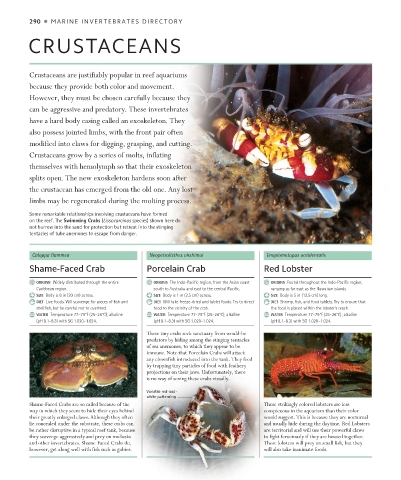
          Calappa flammea                 Neopetrolisthes ohshimai        Enoplometopus occidentalis
         Shame-Faced Crab                Porcelain Crab                   Red Lobster

           ORIGINS  Widely distributed through the entire   ORIGINS  The Indo-Pacific region, from the Asian coast   ORIGINS  Found throughout the Indo-Pacific region,
           Caribbean region.               south to Australia and east to the central Pacific.  ranging as far east as the Hawaiian islands.
           SIZE  Body is 8 in (20 cm) across.  SIZE  Body is 1 in (2.5 cm) across.  SIZE  Body is 5 in (12.5 cm) long.
           DIET  Live foods. Will scavenge for pieces of fish and   DIET  Will take freeze-dried and tablet foods. Try to direct   DIET  Shrimp, fish, and food tablets. Try to ensure that
           shellfish, but be careful not to overfeed.  food to the vicinity of the crab.  the food is placed within the lobster’s reach.
           WATER  Temperature 77–79°F (25–26°C); alkaline    WATER  Temperature 77–79°F (25–26°C); alkaline    WATER  Temperature 77–79°F (25–26°C); alkaline
           (pH 8.1–8.3) with SG 1.020–1.024.  (pH 8.1–8.3) with SG 1.020–1.024.  (pH 8.1–8.3) with SG 1.020–1.024.
                                         These tiny crabs seek sanctuary from would-be
                                         predators by hiding among the stinging tentacles
                                         of sea anemones, to which they appear to be
                                         immune. Note that Porcelain Crabs will attack
                                         any clownfish introduced into the tank. They feed
                                         by trapping tiny particles of food with feathery
                                         projections on their jaws. Unfortunately, there
                                         is no way of sexing these crabs visually.

                                         Variable red-and-
                                         white patterning
         Shame-Faced Crabs are so called because of the                   These strikingly colored lobsters are less
         way in which they seem to hide their eyes behind                 conspicuous in the aquarium than their color
         their greatly enlarged claws. Although they often                would suggest. This is because they are nocturnal
         lie concealed under the substrate, these crabs can               and usually hide during the daytime. Red Lobsters
         be rather disruptive in a typical reef tank, because             are territorial and will use their powerful claws
         they scavenge aggressively and prey on mollusks                  to fight ferociously if they are housed together.
         and other invertebrates. Shame-Faced Crabs do,                   These lobsters will prey on small fish, but they
         however, get along well with fish such as gobies.                will also take inanimate foods.


   US_290-291_Crustaceans_1.indd   290                                                               29/08/18   4:10 PM

