


Page 293 - Encyclopedia of Aquarium and Pond Fish, 3rd Edition
P. 293
CRUSTACEANS    291


          Dardanus lagopodes              Panulirus versicolor            Lissocarcinus laevis
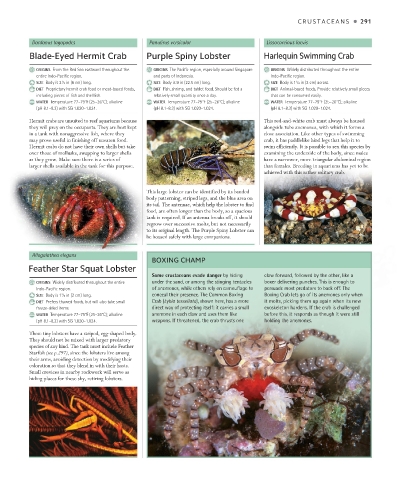
         Blade-Eyed Hermit Crab          Purple Spiny Lobster             Harlequin Swimming Crab

           ORIGINS  From the Red Sea eastward throughout the   ORIGINS  The Pacific region, especially around Singapore   ORIGINS  Widely distributed throughout the entire
           entire Indo-Pacific region.     and parts of Indonesia.          Indo-Pacific region.
           SIZE  Body is 2 ⁄2 in (6 cm) long.  SIZE  Body is 9 in (22.5 cm) long.  SIZE  Body is 1 ⁄4 in (3 cm) across.
                                                                                   1
                  1
           DIET  Proprietary hermit crab food or meat-based foods,   DIET  Fish, shrimp, and tablet food. Should be fed a   DIET  Animal-based foods. Provide relatively small pieces
           including pieces of fish and shellfish.  relatively small quantity once a day.  that can be consumed easily.
           WATER  Temperature 77–79°F (25–26°C); alkaline    WATER  Temperature 77–79°F (25–26°C); alkaline    WATER  Temperature 77–79°F (25–26°C); alkaline
           (pH 8.1–8.3) with SG 1.020–1.024.  (pH 8.1–8.3) with SG 1.020–1.024.  (pH 8.1–8.3) with SG 1.020–1.024.
         Hermit crabs are unsuited to reef aquariums because              This red-and-white crab must always be housed
         they will prey on the occupants. They are best kept              alongside tube anemones, with which it forms a
         in a tank with nonaggressive fish, where they                    close association. Like other types of swimming
         may prove useful in finishing off uneaten food.                  crab, it has paddlelike hind legs that help it to
         Hermit crabs do not have their own shells but take               swim efficiently. It is possible to sex this species by
         over those of mollusks, swapping to larger shells                examining the underside of the body, since males
         as they grow. Make sure there is a series of                     have a narrower, more triangular abdominal region
         larger shells available in the tank for this purpose.            than females. Breeding in aquariums has yet to be
                                                                          achieved with this rather solitary crab.

                                         This large lobster can be identified by its banded
                                         body patterning, striped legs, and the blue area on
                                         its tail. The antennae, which help the lobster to find
                                         food, are often longer than the body, so a spacious
                                         tank is required. If an antenna breaks off, it should
                                         regrow over successive molts, but not necessarily
                                         to its original length. The Purple Spiny Lobster can
                                         be housed safely with large companions.

          Allogalathea elegans
                                           BOXING CHAMP
         Feather Star Squat Lobster
                                           Some crustaceans evade danger by hiding   claw forward, followed by the other, like a
           ORIGINS  Widely distributed throughout the entire    under the sand, or among the stinging tentacles   boxer delivering punches. This is enough to
           Indo-Pacific region.            of anemones, while others rely on camouflage to   persuade most predators to back off. The
           SIZE  Body is 1 ⁄4 in (2 cm) long.  conceal their presence. The Common Boxing   Boxing Crab lets go of its anemones only when
                  3
           DIET  Prefers thawed foods, but will also take small   Crab (Lybia tessellata), shown here, has a more   it molts, picking them up again when its new
           freeze-dried items.             direct way of protecting itself: it carries a small   exoskeleton hardens. If the crab is challenged
           WATER  Temperature 77–79°F (25–26°C); alkaline    anemone in each claw and uses them like   before this, it responds as though it were still
           (pH 8.1–8.3) with SG 1.020–1.024.  weapons. If threatened, the crab thrusts one   holding the anemones.
         These tiny lobsters have a striped, egg-shaped body.
         They should not be mixed with larger predatory
         species of any kind. The tank must include Feather
         Starfish (see p.297), since the lobsters live among
         their arms, avoiding detection by modifying their
         coloration so that they blend in with their hosts.
         Small crevices in nearby rockwork will serve as
         hiding places for these shy, retiring lobsters.


   US_290-291_Crustaceans_1.indd   291                                                               29/08/18   4:10 PM

