


Page 39 - Encyclopedia of Aquarium and Pond Fish, 3rd Edition
P. 39
CHOOSING PLANTS     37

                                                          divided like this, since they have only one growing point. If an
                                                          established tuberous plant is moved elsewhere, some of its
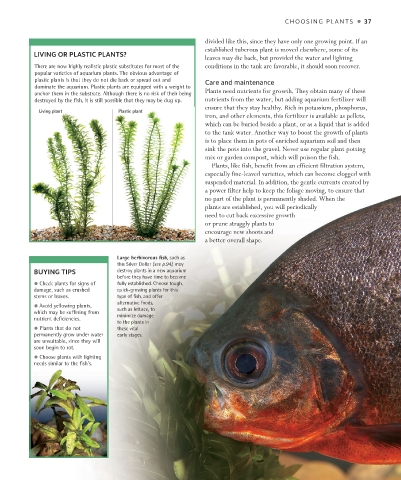
          LIVING OR PLASTIC PLANTS?                       leaves may die back, but provided the water and lighting
           There are now highly realistic plastic substitutes for most of the   conditions in the tank are favorable, it should soon recover.
           popular varieties of aquarium plants. The obvious advantage of
           plastic plants is that they do not die back or spread out and   Care and maintenance
           dominate the aquarium. Plastic plants are equipped with a weight to   Plants need nutrients for growth. They obtain many of these
           anchor them in the substrate. Although there is no risk of their being
           destroyed by the fish, it is still possible that they may be dug up.  nutrients from the water, but adding aquarium fertilizer will
                                                          ensure that they stay healthy. Rich in potassium, phosphorus,
            Living plant          Plastic plant
                                                          iron, and other elements, this fertilizer is available as pellets,
                                                          which can be buried beside a plant, or as a liquid that is added
                                                          to the tank water. Another way to boost the growth of plants
                                                          is to place them in pots of enriched aquarium soil and then
                                                          sink the pots into the gravel. Never use regular plant potting
                                                          mix or garden compost, which will poison the fish.
                                                           Plants, like fish, benefit from an efficient filtration system,
                                                          especially fine-leaved varieties, which can become clogged with
                                                          suspended material. In addition, the gentle currents created by
                                                          a power filter help to keep the foliage moving, to ensure that
                                                          no part of the plant is permanently shaded. When the
                                                          plants are established, you will periodically
                                                          need to cut back excessive growth
                                                          or prune straggly plants to
                                                          encourage new shoots and
                                                          a better overall shape.

                                 Large herbivorous fish, such as
                                 this Silver Dollar (see p.94), may
          BUYING TIPS            destroy plants in a new aquarium
                                 before they have time to become
          •  Check plants for signs of   fully established. Choose tough,
          damage, such as crushed    quick-growing plants for this
          stems or leaves.       type of fish, and offer
          •  Avoid yellowing plants,   alternative foods,
          which may be suffering from   such as lettuce, to
          nutrient deficiencies.  minimize damage
                                 to the plants in
          •  Plants that do not   these vital
          permanently grow under water   early stages.
          are unsuitable, since they will
          soon begin to rot.
          •  Choose plants with lighting
          needs similar to the fish’s.


   US_036-037_Choosing_Plants.indd   37                                                              29/08/18   4:08 PM

