


Page 373 - Encyclopedia of Aquarium and Pond Fish, 3rd Edition
P. 373
OXYGENATORS    371


          Utricularia vulgaris            Ceratophyllum demersum
         Common Bladderwort              Hornwort                         root, but if in contact with a substrate, the leaves
                                                                          will start to anchor the plant in place. Over the
           ORIGINS  Widely distributed in temperate parts of   ORIGINS  May have originated in Asia, but now occurs   course of the growing period, hornwort forms
           Europe, Asia, and North America.   throughout temperate regions of the world.  long strands. As the leaves start to die back, the
           SIZE  Stems reach 6 to 18 in (15–45 cm) in length.  SIZE  Stalks may reach up to 24 in (60 cm) in length.  budlike tips of the strands drop off (or can be
           WATER  Prefers relatively calm water in a sunny position.   WATER  Not fussy about water chemistry; grows well in   cut off) and sink to the bottom of the pond, and
           Hardy to –30°F (–34°C).         both sun and shade. Hardy to –10°F (23°C).  it is from these buds that new plants will develop
           PROPAGATION  Remove young plantlets from an   PROPAGATION  Break up the stems of established plants   the following spring. By the end of the growing
           established plant during the growing season.  during the growing season.  season, Hornwort becomes very straggly, so it is
                                                                          best to pull out the plants at this stage. Hornwort
                                         The unusual name of this plant originates from the   is strictly aquatic and dies back if exposed to the
                                         distinctive broad shape of its growing tip, which is   air for any length of time. It is also fragile, and
                                         reminiscent of a cow’s horn. Hornworts do not   breaks easily when handled.


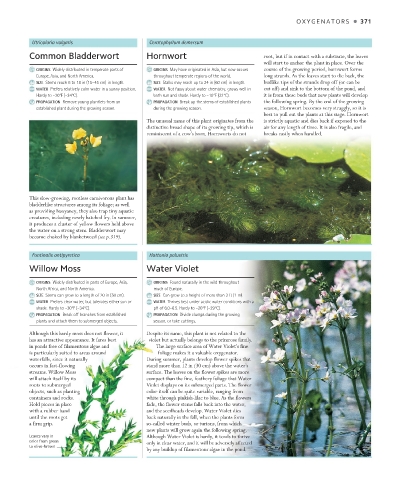
         This slow-growing, rootless carnivorous plant has
         bladderlike structures among its foliage; as well
         as providing buoyancy, they also trap tiny aquatic
         creatures, including newly hatched fry. In summer,
         it produces a cluster of yellow flowers held above
         the water on a strong stem. Bladderwort may
         become choked by blanketweed (see p.319).

          Fontinalis antipyretica         Hottonia palustris
         Willow Moss                     Water Violet

           ORIGINS  Widely distributed in parts of Europe, Asia,   ORIGINS  Found naturally in the wild throughout
           North Africa, and North America.  much of Europe.
           SIZE  Stems can grow to a length of 20 in (50 cm).  SIZE  Can grow to a height of more than 3 ft (1 m).
           WATER  Prefers clear water, but tolerates either sun or   WATER  Thrives best under acidic water conditions with a
           shade. Hardy to –30°F (–34°C).  pH of 6.0–6.5. Hardy to –20°F (–29°C).
           PROPAGATION  Break off branches from established   PROPAGATION  Divide clumps during the growing
           plants and attach them to submerged objects.  season, or take cuttings.
         Although this hardy moss does not flower, it    Despite its name, this plant is not related to the
         has an attractive appearance. It fares best   violet but actually belongs to the primrose family.
         in ponds free of filamentous algae and    The large surface area of Water Violet’s fine
         is particularly suited to areas around   foliage makes it a valuable oxygenator.
         waterfalls, since it naturally    During summer, plants develop flower spikes that
         occurs in fast-flowing          stand more than 12 in (30 cm) above the water’s
         streams. Willow Moss            surface. The leaves on the flower spikes are more
         will attach itself by its       compact than the fine, feathery foliage that Water
         roots to submerged              Violet displays on its submerged parts. The flower
         objects, such as planting       color itself can be quite variable, ranging from
         containers and rocks.           white through pinkish-lilac to blue. As the flowers
         Hold pieces in place            fade, the flower stems falls back into the water,
         with a rubber band              and the seedheads develop. Water Violet dies
         until the roots get             back naturally in the fall, when the plants form
         a firm grip.                    so-called winter buds, or turions, from which
                                         new plants will grow again the following spring.
         Leaves vary in                  Although Water Violet is hardy, it tends to thrive
         color from green                only in clear water, and it will be adversely affected
         to olive-brown
                                         by any buildup of filamentous algae in the pond.


   US_370-371_Oxygenators.indd   371                                                                 29/08/18   4:11 PM

