


Page 44 - Encyclopedia of Aquarium and Pond Fish, 3rd Edition
P. 44
42    FRESHWATER FISH: SETTING UP THE TANK

         the top of the tank, cools, and then sinks back down again.    Connect the airline from the air pump to the airlift tube of the
         It is important that water can move freely around the heater;   undergravel filter. If you are also using an internal power filter,
         otherwise, this circulation will be disrupted and local hot spots   place this close to the surface, and well clear of the substrate,
         will develop in the tank. In a large aquarium, it may be better   so that it can circulate water more effectively.
         to use two widely spaced thermostatic heaters, to ensure a
         more even distribution of warm water.            Final tasks
           Place the thermometer (see p.33) at the opposite end of the   With all the decor and equipment in place, add the plants and
         aquarium from the heater so that it records the minimum   water. When the tank is full, switch on the power. An indicator
         temperature in the tank. (If you are using a separate   light on the heater will tell you whether it is operating, while
         thermostat and heater, position the thermostat there, too.) An   bubbles produced by air pumps and power filters will show
         LCD thermometer attaches to the outside of the glass, but be   that they are functioning properly.
         careful not to touch the display with your fingers, since this   Before introducing the fish, add a commercial seed culture
         will give a false reading. Keep it out of direct sunlight, too,   of beneficial bacteria to the gravel. This can also be useful in
         which will have the same effect. An alcohol thermometer    a tank that does not have an undergravel filter but still relies
         will not suffer from these problems because it attaches to the   on a medium that carries out biological filtration (see p.34)
         inside of the glass, but it may be dislodged by large, active fish.   in some form, such as the sponge in an internal power filter.


         ADDING WATER AND PLANTS
         Never put tap water in the tank without first
         treating it with a water conditioner. This will
         neutralize chlorine and chloramine in the
         water, which can be fatal to fish. Some water
         conditioners contain aloe vera, which helps
         to heal any minor injuries that the fish sustain
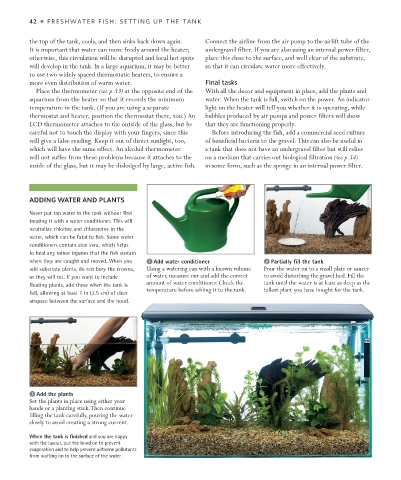
         when they are caught and moved. When you    1  Add water conditioner   2  Partially fill the tank
                                          1
                                                                          2
         add substrate plants, do not bury the crowns,   Using a watering can with a known volume   Pour the water on to a small plate or saucer
         or they will rot. If you want to include   of water, measure out and add the correct   to avoid disturbing the gravel bed. Fill the
         floating plants, add these when the tank is   amount of water conditioner. Check the   tank until the water is at least as deep as the
         full, allowing at least 1 in (2.5 cm) of clear   temperature before adding it to the tank.  tallest plant you have bought for the tank.
         airspace between the surface and the hood.


          3  Add the plants
          3
         Set the plants in place using either your
         hands or a planting stick. Then continue
         filling the tank carefully, pouring the water
         slowly to avoid creating a strong current.
         When the tank is finished and you are happy
         with the layout, put the hood on to prevent
         evaporation and to help prevent airborne pollutants
         from wafting on to the surface of the water.


   US_040-043_Prep_Tank_Brackish.indd   42                                                           29/08/18   4:08 PM

