


Page 41 - Encyclopedia of Aquarium and Pond Fish, 3rd Edition
P. 41
PREPARING THE TANK     39


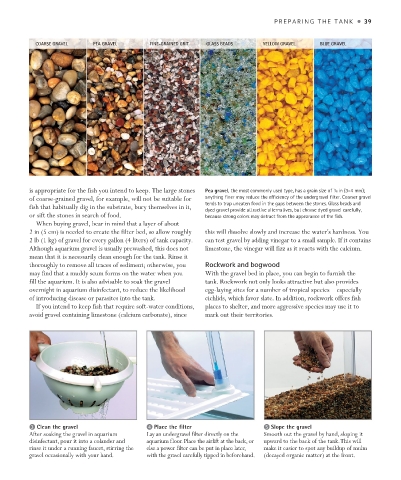
           COARSE GRAVEL   PEA GRAVEL     FINE-GRAINED GRIT  GLASS BEADS  YELLOW GRAVEL  BLUE GRAVEL


         is appropriate for the fish you intend to keep. The large stones   Pea gravel, the most commonly used type, has a grain size of  ⁄8 in (3–4 mm);
                                                                                             1
         of coarse-grained gravel, for example, will not be suitable for   anything finer may reduce the efficiency of the undergravel filter. Coarser gravel
         fish that habitually dig in the substrate, bury themselves in it,   tends to trap uneaten food in the gaps between the stones. Glass beads and
                                                          dyed gravel provide attractive alternatives, but choose dyed gravel carefully,
         or sift the stones in search of food.            because strong colors may detract from the appearance of the fish.
           When buying gravel, bear in mind that a layer of about
         2 in (5 cm) is needed to create the filter bed, so allow roughly    this will dissolve slowly and increase the water’s hardness. You
         2 lb (1 kg) of gravel for every gallon (4 liters) of tank capacity.   can test gravel by adding vinegar to a small sample. If it contains
         Although aquarium gravel is usually prewashed, this does not   limestone, the vinegar will fizz as it reacts with the calcium.
         mean that it is necessarily clean enough for the tank. Rinse it
         thoroughly to remove all traces of sediment; otherwise, you   Rockwork and bogwood
         may find that a muddy scum forms on the water when you    With the gravel bed in place, you can begin to furnish the
         fill the aquarium. It is also advisable to soak the gravel   tank. Rockwork not only looks attractive but also provides
         overnight in aquarium disinfectant, to reduce the likelihood    egg-laying sites for a number of tropical species—especially
         of introducing disease or parasites into the tank.    cichlids, which favor slate. In addition, rockwork offers fish
           If you intend to keep fish that require soft-water conditions,   places to shelter, and more aggressive species may use it to
         avoid gravel containing limestone (calcium carbonate), since   mark out their territories.


          3  Clean the gravel             4  Place the filter              5  Slope the gravel
                                          4
          3
                                                                          5
         After soaking the gravel in aquarium   Lay an undergravel filter directly on the   Smooth out the gravel by hand, sloping it
         disinfectant, pour it into a colander and   aquarium floor. Place the airlift at the back, or   upward to the back of the tank. This will
         rinse it under a running faucet, stirring the   else a power filter can be put in place later,   make it easier to spot any buildup of mulm
         gravel occasionally with your hand.  with the gravel carefully tipped in beforehand.  (decayed organic matter) at the front.


   US_038-039_Prep_Tank_Brackish.indd   39                                                           29/08/18   4:08 PM

