


Page 45 - Encyclopedia of Aquarium and Pond Fish, 3rd Edition
P. 45
PREPARING THE TANK    BRACKISH WATER  43

        Brackish water


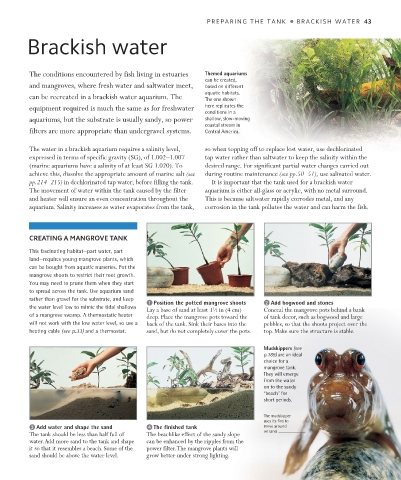
         The conditions encountered by fish living in estuaries   Themed aquariums
                                                          can be created,
         and mangroves, where fresh water and saltwater meet,   based on different
                                                          aquatic habitats.
         can be recreated in a brackish water aquarium. The   The one shown
         equipment required is much the same as for freshwater   here replicates the
                                                          conditions in a
         aquariums, but the substrate is usually sandy, so power   shallow, slow-moving
                                                          coastal stream in
         filters are more appropriate than undergravel systems.  Central America.

         The water in a brackish aquarium requires a salinity level,   so when topping off to replace lost water, use dechlorinated
         expressed in terms of specific gravity (SG), of 1.002–1.007   tap water rather than saltwater to keep the salinity within the
         (marine aquariums have a salinity of at least SG 1.020). To   desired range. For significant partial water changes carried out
         achieve this, dissolve the appropriate amount of marine salt (see   during routine maintenance (see pp.50–51), use salinated water.
         pp.214–215) in dechlorinated tap water, before filling the tank.   It is important that the tank used for a brackish water
         The movement of water within the tank caused by the filter   aquarium is either all-glass or acrylic, with no metal surround.
         and heater will ensure an even concentration throughout the   This is because saltwater rapidly corrodes metal, and any
         aquarium. Salinity increases as water evaporates from the tank,   corrosion in the tank pollutes the water and can harm the fish.


         CREATING A MANGROVE TANK

         This fascinating habitat—part water, part
         land—requires young mangrove plants, which
         can be bought from aquatic nurseries. Pot the
         mangrove shoots to restrict their root growth.
         You may need to prune them when they start
         to spread across the tank. Use aquarium sand
         rather than gravel for the substrate, and keep    1  Position the potted mangrove shoots   2  Add bogwood and stones
                                          1
                                                                          2
         the water level low to mimic the tidal shallows   Lay a base of sand at least 1 ⁄2 in (4 cm)   Conceal the mangrove pots behind a bank
                                                            1
         of a mangrove swamp. A thermostatic heater   deep. Place the mangrove pots toward the   of tank decor, such as bogwood and large
         will not work with the low water level, so use a   back of the tank. Sink their bases into the   pebbles, so that the shoots project over the
         heating cable (see p.33) and a thermostat.  sand, but do not completely cover the pots.  top. Make sure the structure is stable.
                                                                          Mudskippers (see
                                                                          p.189) are an ideal
                                                                          choice for a
                                                                          mangrove tank.
                                                                          They will emerge
                                                                          from the water
                                                                          on to the sandy
                                                                          “beach” for
                                                                          short periods.

                                                                          The mudskipper
                                                                          uses its fins to
          3  Add water and shape the sand   4  The finished tank          move around
          3
                                          4
         The tank should be less than half full of   The beachlike effect of the sandy slope    on land
         water. Add more sand to the tank and shape   can be enhanced by the ripples from the
         it so that it resembles a beach. Some of the   power filter. The mangrove plants will
         sand should be above the water level.   grow better under strong lighting.


   US_040-043_Prep_Tank_Brackish.indd   43                                                           29/08/18   4:08 PM

