


Page 46 - Encyclopedia of Aquarium and Pond Fish, 3rd Edition
P. 46
44    FRESHWATER FISH: SETTING UP THE TANK

         Choosing and introducing fish


         Once the aquarium is fully prepared and you are certain that everything is functioning
         properly, you can start to introduce the fish. Although suppliers can ship stock to you,
         it is probably best to visit a local store, especially when starting out, so that you can
         see the fish firsthand. Ask experienced aquarists to recommend a store—ideally one
         that belongs to a recognized trade association. Such bodies run specialized training
         courses for staff, so you are more likely to receive genuine, professional advice.

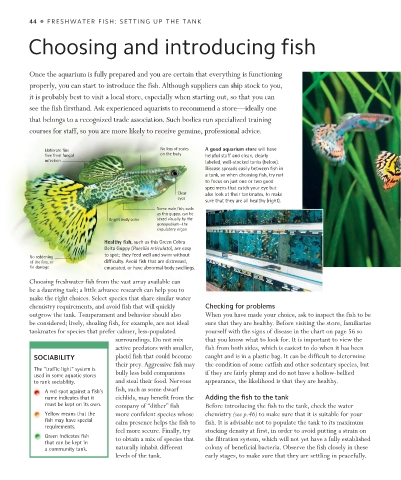
             Elaborate fins                  No loss of scales   A good aquarium store will have
             free from fungal                on the body  helpful staff and clean, clearly
             infection                                    labeled, well-stocked tanks (below).
                                                          Disease spreads easily between fish in
                                                          a tank, so when choosing fish, try not
                                                          to focus on just one or two good
                                                          specimens that catch your eye but
                                                  Clear   also look at their tankmates, to make
                                                  eyes    sure that they are all healthy (right).
                                            Some male fish, such
                                            as this guppy, can be
                               Bright body color  sexed visually by the
                                            gonopodium—the
                                            copulatory organ
                              Healthy fish, such as this Green Cobra
                              Delta Guppy (Poecilia reticulata), are easy
                              to spot; they feed well and swim without
         No reddening
         of the fins, or      difficulty. Avoid fish that are distressed,
         fin damage           emaciated, or have abnormal body swellings.
         Choosing freshwater fish from the vast array available can
         be a daunting task; a little advance research can help you to
         make the right choices. Select species that share similar water
         chemistry requirements, and avoid fish that will quickly   Checking for problems
         outgrow the tank. Temperament and behavior should also    When you have made your choice, ask to inspect the fish to be
         be considered; lively, shoaling fish, for example, are not ideal   sure that they are healthy. Before visiting the store, familiarize
         tankmates for species that prefer calmer, less-populated   yourself with the signs of disease in the chart on page 56 so
                                 surroundings. Do not mix   that you know what to look for. It is important to view the
                                 active predators with smaller,   fish from both sides, which is easiest to do when it has been
          SOCIABILITY            placid fish that could become   caught and is in a plastic bag. It can be difficult to determine
                                 their prey. Aggressive fish may   the condition of some catfish and other sedentary species, but
          The “traffic light” system is   bully less bold companions   if they are fairly plump and do not have a hollow-bellied
          used in some aquatic stores
          to rank sociability.   and steal their food. Nervous   appearance, the likelihood is that they are healthy.
             A red spot against a fish’s   fish, such as some dwarf
             name indicates that it   cichlids, may benefit from the   Adding the fish to the tank
             must be kept on its own.  company of “dither” fish—   Before introducing the fish to the tank, check the water
             Yellow means that the    more confident species whose   chemistry (see p.46) to make sure that it is suitable for your
             fish may have special   calm presence helps the fish to   fish. It is advisable not to populate the tank to its maximum
             requirements.
                                 feel more secure. Finally, try   stocking density at first, in order to avoid putting a strain on
             Green indicates fish    to obtain a mix of species that   the filtration system, which will not yet have a fully established
             that can be kept in
             a community tank.   naturally inhabit different   colony of beneficial bacteria. Observe the fish closely in these
                                 levels of the tank.      early stages, to make sure that they are settling in peacefully.


   US_044-045_Choosing_Intro_Fish.indd   44                                                          29/08/18   4:08 PM

