


Page 58 - Encyclopedia of Aquarium and Pond Fish, 3rd Edition
P. 58
56    FRESHWATER FISH:  ILLNESS AND TREATMENT


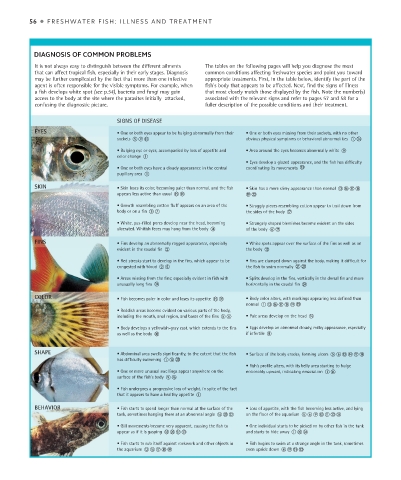
          DIAGNOSIS OF COMMON PROBLEMS
           It is not always easy to distinguish between the different ailments    The tables on the following pages will help you diagnose the most
           that can affect tropical fish, especially in their early stages. Diagnosis   common conditions affecting freshwater species and point you toward
           may be further complicated by the fact that more than one infective   appropriate treatments. First, in the table below, identify the part of the
           agent is often responsible for the visible symptoms. For example, when   fish’s body that appears to be affected. Next, find the signs of illness
           a fish develops white spot (see p.54), bacteria and fungi may gain   that most closely match those displayed by the fish. Note the number(s)
           access to the body at the site where the parasites initially  attacked,   associated with the relevant signs and refer to pages 57 and 58 for a
           confusing the diagnostic picture.              fuller description of the possible conditions and their treatment.

                                 SIGNS OF DISEASE
           EYES                  • One or both eyes appear to be bulging abnormally from their   • One or both eyes missing from their sockets, with no other
                                 sockets ⑤ ⑨ ⑫                       obvious physical symptoms or behavioral abnormalities ①
                                 • Bulging eye or eyes, accompanied by loss of appetite and    • Area around the eyes becomes abnormally white  ⑨
                                 color change  ①
                                                                     • Eyes develop a glazed appearance, and the fish has difficulty
                                 • One or both eyes have a cloudy appearance in the central   coordinating its movements
                                 pupillary area  ①
           SKIN                  • Skin loses its color, becoming paler than normal, and the fish   • Skin has a more slimy appearance than normal  ⑬ ⑯ ⑰ ⑱
                                 appears less active than usual  ⑮ ⑲  ⑲
                                 • Growth resembling cotton fluff appears on an area of the   • Straggly pieces resembling cotton appear to trail down from
                                 body or on a fin  ③ ⑦               the sides of the body  ⑰
                                 • White, pus-filled pores develop near the head, becoming   • Strangely shaped blemishes become evident on the sides
                                 ulcerated. Whitish feces may hang from the body  ⑭  of the body  ⑥ ⑰
           FINS                  • Fins develop an abnormally ragged appearance, especially   • White spots appear over the surface of the fins as well as on
                                 evident in the caudal fin  ②        the body  ⑬
                                 • Red streaks start to develop in the fins, which appear to be   • Fins are clamped down against the body, making it difficult for
                                 congested with blood  ② ⑤           the fish to swim normally
                                 • Areas missing from the fins; especially evident in fish with   • Splits develop in the fins, vertically in the dorsal fin and more
                                 unusually long fins                 horizontally in the caudal fin
           COLOR                 • Fish becomes paler in color and loses its appetite  ⑮ ⑲  • Body color alters, with markings appearing less defined than
                                                                     normal  ① ⑬ ⑯ ⑰ ⑱ ⑲
                                 • Reddish areas become evident on various parts of the body,
                                 including the mouth, anal region, and bases of the fins  ⑤ ⑥   • Pale areas develop on the head  ⑭
                                 • Body develops a yellowish-gray cast, which extends to the fins   • Eggs develop an abnormal cloudy, milky appearance, especially
                                 as well as the body  ⑱              if infertile  ⑧

           SHAPE                 • Abdominal area swells significantly, to the extent that the fish   • Surface of the body erodes, forming ulcers  ⑤ ⑥ ⑬ ⑭ ⑰ ⑱
                                 has difficulty swimming  ① ⑫
                                                                     • Fish’s profile alters, with its belly area starting to bulge
                                 • One or more unusual swellings appear anywhere on the   noticeably upward, indicating emaciation  ① ⑭
                                 surface of the fish’s body  ⑨ ⑯
                                 • Fish undergoes a progressive loss of weight, in spite of the fact
                                 that it appears to have a healthy appetite  ①
           BEHAVIOR              • Fish starts to spend longer than normal at the surface of the   • Loss of appetite, with the fish becoming less active, and lying
                                 tank, sometimes hanging there at an abnormal angle  ⑯ ⑳      on the floor of the aquarium  ⑤ ⑥ ⑨ ⑩ ⑪
                                 • Gill movements become very apparent, causing the fish to   • One individual starts to be picked on by other fish in the tank
                                 appear as if it is gasping  ⑱ ⑳        and starts to hide away  ① ⑮
                                 • Fish starts to rub itself against rockwork and other objects in   • Fish begins to swim at a strange angle in the tank, sometimes
                                 the aquarium ⑬ ⑯ ⑰ ⑱ ⑲              even upside down  ④ ⑲


   US_054-059_Illness_FW.indd   56                                                                   29/08/18   4:08 PM

