


Page 59 - Encyclopedia of Aquarium and Pond Fish, 3rd Edition
P. 59
HEALTH CONCERNS    57


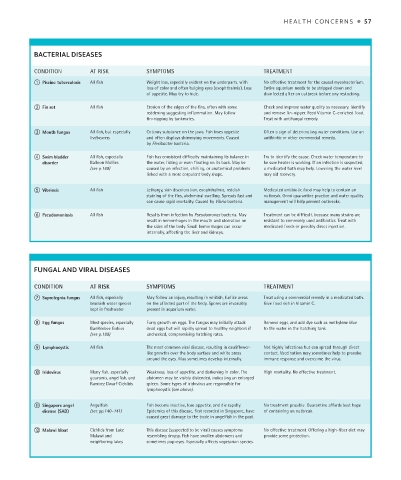
          BACTERIAL DISEASES

          CONDITION       AT RISK        SYMPTOMS                         TREATMENT
          ①  Piscine tuberculosis  All fish  Weight loss, especially evident on the underparts, with   No effective treatment for the causal mycobacterium.
                                         loss of color and often bulging eyes (exophthalmia). Loss   Entire aquarium needs to be stripped down and
                                         of appetite. May try to hide.    disinfected after an outbreak before any restocking.
          ②  Fin rot      All fish       Erosion of the edges of the fins, often with some   Check and improve water quality as necessary. Identify
                                         reddening suggesting inflammation. May follow    and remove fin-nipper. Feed Vitamin C–enriched food.
                                         fin-nipping by tankmates.        Treat with antifungal remedy.
          ③  Mouth fungus  All fish, but especially   Cottony substance on the jaws. Fish loses appetite    Often a sign of deteriorating water conditions. Use an
                          livebearers    and often displays shimmying movements. Caused    antibiotic or other commercial remedy.
                                         by Flexibacter bacteria.
          ④   Swim bladder   All fish, especially   Fish has consistent difficulty maintaining its balance in   Try to identify the cause. Check water temperature to
             disorder     Balloon Mollies    the water, listing or even floating on its back. May be   be sure heater is working. If an infection is suspected,
                          (see p.169)    caused by an infection, chilling, or anatomical problems   a medicated bath may help. Lowering the water level
                                         linked with a more corpulent body shape.  may aid recovery.
          ⑤  Vibriosis    All fish       Lethargy, skin discoloration, exophthalmia, reddish   Medicated antibiotic food may help to contain an
                                         staining of the fins, abdominal swelling. Spreads fast and   outbreak. Good quarantine practice and water quality
                                         can cause rapid mortality. Caused by Vibrio bacteria.  management will help prevent outbreaks.
          ⑥  Pseudomoniasis  All fish    Results from infection by Pseudomonas bacteria. May   Treatment can be difficult, because many strains are
                                         result in hemorrhages in the mouth and ulceration on    resistant to commonly used antibiotics. Treat with
                                         the sides of the body. Small hemorrhages can occur   medicated foods or possibly direct injection.
                                         internally, affecting the liver and kidneys.


          FUNGAL AND VIRAL DISEASES

          CONDITION       AT RISK        SYMPTOMS                         TREATMENT
          ⑦  Saprolegnia fungus  All fish, especially   May follow an injury, resulting in whitish, furlike areas   Treat using a commercial remedy in a medicated bath.
                          brackish water species   on the affected part of the body. Spores are invariably   Give food rich in Vitamin C.
                          kept in freshwater  present in aquarium water.
          ⑧  Egg fungus   Most species, especially   Furry growth on eggs. The fungus may initially attack   Remove eggs, and add dye such as methylene blue
                          Bumblebee Gobies    dead eggs but will rapidly spread to healthy neighbors if   to the water in the hatching tank.
                          (see p.189)    unchecked, compromising hatching rates.
          ⑨ Lymphocystis  All fish       The most common viral disease, resulting in cauliflower-  Not highly infectious but can spread through direct
                                         like growths over the body surface and white areas   contact. Vaccination may sometimes help to provoke
                                         around the eyes. May sometimes develop internally.  immune response and overcome the virus.

          ⑩  Iridovirus   Many fish, especially   Weakness, loss of appetite, and darkening in color. The   High mortality. No effective treatment.
                          gouramis, angelfish, and   abdomen may be visibly distended, indicating an enlarged
                          Ramirez Dwarf Cichlids  spleen. Some types of iridovirus are responsible for
                                         lymphocystis (see above).
          ⑪   Singapore angel    Angelfish    Fish become inactive, lose appetite, and die rapidly.   No treatment possible. Quarantine affords best hope
             disease (SAD)  (see pp.140–141)  Epidemics of this disease, first recorded in Singapore, have   of containing an outbreak.
                                         caused great damage to the trade in angelfish in the past.

          ⑫  Malawi bloat  Cichlids from Lake   This disease (suspected to be viral) causes symptoms   No effective treatment. Offering a high-fiber diet may
                          Malawi and     resembling dropsy. Fish have swollen abdomens and   provide some protection.
                          neighboring lakes  sometimes pop-eyes. Especially affects vegetarian species.


   US_054-059_Illness_FW.indd   57                                                                   29/08/18   4:08 PM

