


Page 60 - Encyclopedia of Aquarium and Pond Fish, 3rd Edition
P. 60
58    FRESHWATER FISH:  ILLNESS AND TREATMENT


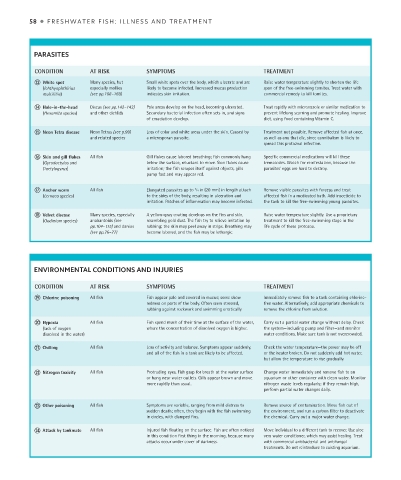
          PARASITES

           CONDITION      AT RISK        SYMPTOMS                         TREATMENT
           ⑬  White spot   Many species, but   Small white spots over the body, which ulcerate and are   Raise water temperature slightly to shorten the life
             (Ichthyophthirius   especially mollies    likely to become infected. Increased mucus production   span of the free-swimming tomites. Treat water with
             multifiliis)  (see pp.168–169)  indicates skin irritation.   commercial remedy to kill tomites.
           ⑭    Hole-in-the-head   Discus (see pp.142–143)    Pale areas develop on the head, becoming ulcerated.   Treat rapidly with micronazole or similar medication to
             (Hexamita species)   and other cichlids  Secondary bacterial infection often sets in, and signs   prevent lifelong scarring and promote healing. Improve
                                         of emaciation develop.           diet, using food containing Vitamin C.
           ⑮  Neon Tetra disease  Neon Tetras (see p.99)   Loss of color and white areas under the skin. Caused by    Treatment not possible. Remove affected fish at once,
                          and related species  a microsporan parasite.    as well as any that die, since cannibalism is likely to
                                                                          spread this protozoal infection.
           ⑯  Skin and gill flukes   All fish  Gill flukes cause labored breathing; fish commonly hang   Specific commercial medications will kill these
             (Gyrodactylus and           below the surface, reluctant to move. Skin flukes cause   trematodes. Watch for reinfestation, because the
             Dactylogyrus)               irritation; the fish scrapes itself against objects, gills   parasites’ eggs are hard to destroy.
                                         pump fast and may appear red.
           ⑰  Anchor worm   All fish     Elongated parasites up to  ⁄4 in (20 mm) in length attach   Remove visible parasites with forceps and treat
                                                       3
             (Lernaea species)           to the sides of the body, resulting in ulceration and   affected fish in a medicated bath. Add insecticide to
                                         irritation. Patches of inflammation may become infected.   the tank to kill the free-swimming young parasites.
           ⑱  Velvet disease    Many species, especially   A yellow-gray coating develops on the fins and skin,   Raise water temperature slightly. Use a proprietary
             (Oodinium species)  anabantoids (see   resembling gold dust. The fish try to relieve irritation by   treatment to kill the free-swimming stage in the
                          pp.104–115) and danios   rubbing; the skin may peel away in strips. Breathing may   life cycle of these protozoa.
                          (see pp.76–77)  become labored, and the fish may be lethargic.


          ENVIRONMENTAL CONDITIONS AND INJURIES

           CONDITION      AT RISK        SYMPTOMS                         TREATMENT
           ⑲  Chlorine poisoning  All fish  Fish appear pale and covered in mucus; some show   Immediately remove fish to a tank containing chlorine-
                                         redness on parts of the body. Often seem stressed,   free water. Alternatively, add appropriate chemicals to
                                         rubbing against rockwork and swimming erratically.  remove the chlorine from solution.
           ⑳  Hypoxia     All fish       Fish spend much of their time at the surface of the water,   Carry out a partial water change without delay. Check
             (lack of oxygen             where the concentration of dissolved oxygen is higher.  the system—including pump and filter—and monitor
             dissolved in the water)                                      water conditions. Make sure tank is not overcrowded.
              Chilling    All fish       Loss of activity and balance. Symptoms appear suddenly,   Check the water temperature—the power may be off
                                         and all of the fish in a tank are likely to be affected.  or the heater broken. Do not suddenly add hot water,
                                                                          but allow the temperature to rise gradually.

              Nitrogen toxicity  All fish  Protruding eyes. Fish gasp for breath at the water surface   Change water immediately and remove fish to an
                                         or hang near water outlets. Gills appear brown and move   aquarium or other container with clean water. Monitor
                                         more rapidly than usual.         nitrogen waste levels regularly; if they remain high,
                                                                          perform partial water changes daily.
              Other poisoning  All fish  Symptoms are variable, ranging from mild distress to   Remove source of contamination. Move fish out of
                                         sudden death; often, they begin with the fish swimming   the environment, and run a carbon filter to deactivate
                                         in circles, with clamped fins.   the chemical. Carry out a major water change.

              Attack by tankmate  All fish  Injured fish floating on the surface. Fish are often noticed   Move individual to a different tank to recover. Use aloe
                                         in this condition first thing in the morning, because many   vera water conditioner, which may assist healing. Treat
                                         attacks occur under cover of darkness.   with commercial antibacterial and antifungal
                                                                          treatments. Do not reintroduce to existing aquarium.


   US_054-059_Illness_FW.indd   58                                                                   29/08/18   4:08 PM

