


Page 62 - Encyclopedia of Aquarium and Pond Fish, 3rd Edition
P. 62
60    FRESHWATER FISH: BREEDING

         Reproductive behavior


         Fish can be divided into two broad categories on the basis of their
         breeding behavior. Egg-layers, which form the majority, practice
         external fertilization, while in livebearers the eggs are fertilized in
         the female’s body and emerge as fully formed young. Some species
         show little regard for their offspring and cannibalize their own eggs
         or fry. Others display surprisingly high levels of parental care.

         When fish mate, it is known as spawning. In egg-layers, this
         involves the male’s releasing sperm into the water at roughly
         the same time that the female expels her eggs              This temporarily flooded forest in the Amazon region of
         nearby so that fertilization occurs outside                South America provides a spawning ground for egg-laying
                                                                    fish such as discus. Breeding behavior in the wild is often
         the female’s body. This is a rather                        seasonal and influenced by rainfall patterns.

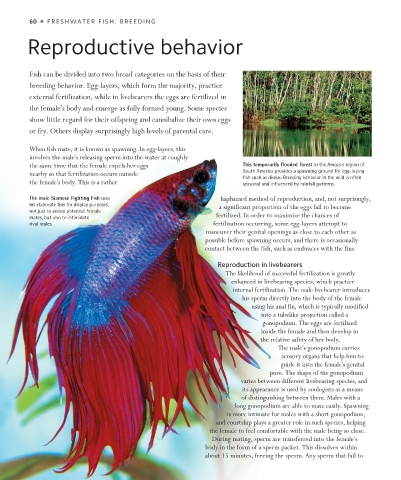
         The male Siamese Fighting Fish uses                  haphazard method of reproduction, and, not surprisingly,
         his elaborate fins for display purposes,            a significant proportion of the eggs fail to become
         not just to entice potential female                 fertilized. In order to maximize the chances of
         mates, but also to intimidate
         rival males.                                       fertilization occurring, some egg-layers attempt to
                                                          maneuver their genital openings as close to each other as
                                                          possible before spawning occurs, and there is occasionally
                                                          contact between the fish, such as embraces with the fins.

                                                             Reproduction in livebearers
                                                               The likelihood of successful fertilization is greatly
                                                                 enhanced in livebearing species, which practice
                                                                 internal fertilization. The male livebearer introduces
                                                                    his sperm directly into the body of the female
                                                                      using his anal fin, which is typically modified
                                                                         into a tubelike projection called a
                                                                         gonopodium. The eggs are fertilized
                                                                         inside the female and then develop in
                                                                         the relative safety of her body.
                                                                              The male’s gonopodium carries
                                                                               sensory organs that help him to
                                                                              guide it into the female’s genital
                                                                           pore. The shape of the gonopodium
                                                                   varies between different livebearing species, and
                                                                    its appearance is used by zoologists as a means
                                                                    of distinguishing between them. Males with a
                                                                  long gonopodium are able to mate easily. Spawning
                                                                is more intimate for males with a short gonopodium,
                                                             and courtship plays a greater role in such species, helping
                                                           the female to feel comfortable with the male being so close.
                                                           During mating, sperm are transferred into the female’s
                                                          body in the form of a sperm packet. This dissolves within
                                                          about 15 minutes, freeing the sperm. Any sperm that fail to


   US_060-063_Reproductive_Behav.indd   60                                                           29/08/18   4:08 PM

