


Page 63 - Encyclopedia of Aquarium and Pond Fish, 3rd Edition
P. 63
REPRODUCTIVE BEHAVIOR    61


                                                           SEXING FISH
                                                           In some species, there are obvious differences between the sexes.
                                                           This is called sexual dimorphism. Male livebearers, for example, are
                                                           smaller than females and possess a gonopodium. In many tropical
                                                           species, males tend to be more colorful and have more elaborate
                                                           fins, which they use for ritual display during courtship. However,
                                                           many of the fish sold in aquatic stores are immature, so it will not
                                                           be possible to determine their gender at the time of purchase. Other
                                                           distinguishing features, such as a specific breeding coloration, may
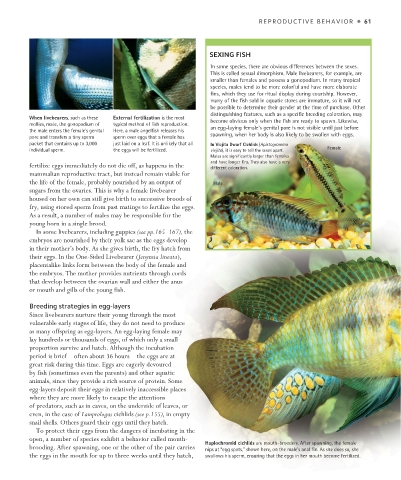
         When livebearers, such as these   External fertilization is the most
         mollies, mate, the gonopodium of   typical method of fish reproduction.   become obvious only when the fish are ready to spawn. Likewise,
         the male enters the female’s genital   Here, a male angelfish releases his   an egg-laying female’s genital pore is not visible until just before
         pore and transfers a tiny sperm   sperm over eggs that a female has    spawning, when her body is also likely to be swollen with eggs.
         packet that contains up to 3,000   just laid on a leaf. It is unlikely that all   In Viejita Dwarf Cichlids (Apistogramma
         individual sperm.      the eggs will be fertilized.  viejita), it is easy to tell the sexes apart.   Female
                                                           Males are significantly larger than females
         fertilize eggs immediately do not die off, as happens in the   and have longer fins. They also have a very
                                                           different coloration.
         mammalian reproductive tract, but instead remain viable for
         the life of the female, probably nourished by an output of   Male
         sugars from the ovaries. This is why a female livebearer
         housed on her own can still give birth to successive broods of
         fry, using stored sperm from past matings to fertilize the eggs.
         As a result, a number of males may be responsible for the
         young born in a single brood.
           In some livebearers, including guppies (see pp.165–167), the
         embryos are nourished by their yolk sac as the eggs develop
         in their mother’s body. As she gives birth, the fry hatch from
         their eggs. In the One-Sided Livebearer (Jenynsia lineata),
         placentalike links form between the body of the female and
         the embryos. The mother provides nutrients through cords
         that develop between the ovarian wall and either the anus
         or mouth and gills of the young fish.

         Breeding strategies in egg-layers
         Since livebearers nurture their young through the most
         vulnerable early stages of life, they do not need to produce
         as many offspring as egg-layers. An egg-laying female may
         lay hundreds or thousands of eggs, of which only a small
         proportion survive and hatch. Although the incubation
         period is brief—often about 36 hours—the eggs are at
         great risk during this time. Eggs are eagerly devoured
         by fish (sometimes even the parents) and other aquatic
         animals, since they provide a rich source of protein. Some
         egg-layers deposit their eggs in relatively inaccessible places
         where they are more likely to escape the attentions
         of predators, such as in caves, on the underside of leaves, or
         even, in the case of Lamprologus cichlids (see p.155), in empty
         snail shells. Others guard their eggs until they hatch.
           To protect their eggs from the dangers of incubating in the
         open, a number of species exhibit a behavior called mouth-
         brooding. After spawning, one or the other of the pair carries   Haplochromid cichlids are mouth-brooders. After spawning, the female
                                                          nips at “egg spots,” shown here, on the male’s anal fin. As she does so, she
         the eggs in the mouth for up to three weeks until they hatch,   swallows his sperm, ensuring that the eggs in her mouth become fertilized.


   US_060-063_Reproductive_Behav.indd   61                                                           29/08/18   4:08 PM

