


Page 71 - Encyclopedia of Aquarium and Pond Fish, 3rd Edition
P. 71
BREEDING IN AQUARIUMS     69

                                                                                         Many freshwater
                                                                                         species are now bred
         GROWTH AND DEVELOPMENT OF A PLATY                                               commercially for the
                                                                                         aquarium trade. This
         Young livebearers, such as platies, are free-swimming at birth and have         breeding farm is in
         a remarkably consistent growth rate, averaging up to  ⁄100 in (0.3 mm)          Singapore, where the
                                           1
         per day. Initially, both sexes develop at the same pace, but the females        climate allows fry to be
         have a growth spurt after maturity and eventually outgrow the males.            reared in outdoor ponds.
                                                                                         The fish eat naturally
                                                                                         occurring foods plus
                                        Three weeks after                                dietary supplements.
                                        birth, traces of color
                                        are starting to show on
                                        this young fish, but it is
                                        still quite inconspicuous   Problems and solutions
                                        in the tank. It is now   Difficulties can crop up at any stage during the breeding cycle,
                                        large enough to be safe
                                        from being eaten by the   starting with the failure of the fish to spawn at all. It may be
                                        other tank occupants.  that you do not have a pair, or that the fish are not yet mature
                                                          enough to breed. If the fish spawn but the eggs prove to be
                                        At five weeks old, the   infertile, the male of the pair could either be too old or, if he
                                        coloration of the fish is   is a livebearer, have a damaged gonopodium. Swap the males
                                        becoming clearer. The   of different pairs around to see if this has any effect. With egg-
                                        fins are proportionately
                                        larger and more   layers such as barbs, add an extra male to the spawning tank to
                                        elaborate. The body is   increase the likelihood of success. If eggs are attacked by
                                        less streamlined, with    fungus, you can treat the water with a little methylene blue
                                        a more angular back
                                        and a bulkier abdomen.  to control the problem, although the presence of fungus may
                                                          also be an indication that the water temperature is too low.
                                        By nine weeks of age,   If the young fail to thrive, or even die off, reexamine their
                                        the patterning and   feeding regimen. Study the abdomens of fry with a hand lens;
                                        richness of coloration   their bodies should be transparent enough to see if there is food
                                        are fully apparent. Now   in the gut. If there is not, the food you are giving the fry may
                                        sexually mature, the fish
                                        can be identified as a   be too large for them to eat. The fry may also perish if the
                                        male by its gon opodium,   water quality deteriorates, so monitor this closely during the
                                        which is just visible   rearing period. There will inevitably be a few deformed fry
                                        behind the pelvic fin.
                                                          in any brood, and these should be humanely culled.
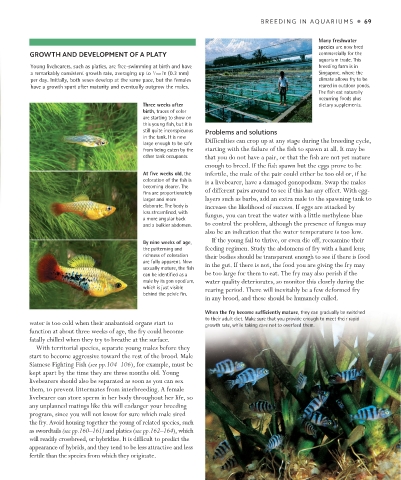
                                                          When the fry become sufficiently mature, they can gradually be switched
                                                          to their adult diet. Make sure that you provide enough to meet their rapid
         water is too cold when their anabantoid organs start to   growth rate, while taking care not to overfeed them.
         function at about three weeks of age, the fry could become
         fatally chilled when they try to breathe at the surface.
           With territorial species, separate young males before they
         start to become aggressive toward the rest of the brood. Male
         Siamese Fighting Fish (see pp.104–106), for example, must be
         kept apart by the time they are three months old. Young
         livebearers should also be separated as soon as you can sex
         them, to prevent littermates from interbreeding. A female
         livebearer can store sperm in her body throughout her life, so
         any unplanned matings like this will endanger your breeding
         program, since you will not know for sure which male sired
         the fry. Avoid housing together the young of related species, such
         as swordtails (see pp.160–161) and platies (see pp.162–164), which
         will readily crossbreed, or hybridize. It is difficult to predict the
         appearance of hybrids, and they tend to be less attractive and less
         fertile than the species from which they originate.


   US_064-069_Breeding_In_Aquaria.indd   69                                                          29/08/18   4:09 PM

