


Page 68 - Encyclopedia of Aquarium and Pond Fish, 3rd Edition
P. 68
66    FRESHWATER FISH: BREEDING

                                                          to 90°F (32°C). The disadvantage of speeding up gestation is
                                                          that higher temperatures also quicken the rest of the life cycle
                                                          of the fish, thus shortening their life span.
                                                           Although most livebearers produce offspring readily, even in
                                                          a community tank, few of the fry survive to adulthood because
                                                          they are eagerly devoured by other tank occupants— often
                                                          including their own mother. To avoid this unnecessary carnage,
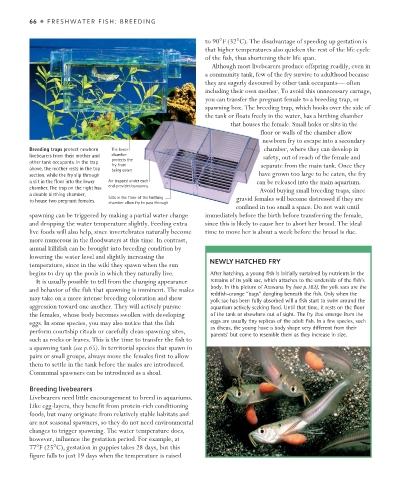
                                                          you can transfer the pregnant female to a breeding trap, or
                                                          spawning box. The breeding trap, which hooks over the side of
                                                          the tank or floats freely in the water, has a birthing chamber
                                                                 that houses the female. Small holes or slits in the
                                                                         floor or walls of the chamber allow
                                                                         newborn fry to escape into a secondary
         Breeding traps protect newborn   The lower                       chamber, where they can develop in
         livebearers from their mother and   chamber                      safety, out of reach of the female and
         other tank occupants. In the trap   protects the                separate from the main tank. Once they
                                fry from
         above, the mother rests in the top   being eaten
         section, while the fry slip through                            have grown too large to be eaten, the fry
         a slit in the floor into the lower   Air trapped under each    can be released into the main aquarium.
         chamber. The trap on the right has   end provides buoyancy      Avoid buying small breeding traps, since
         a double birthing chamber,    Slits in the floor of the birthing
         to house two pregnant females.  chamber allow fry to pass through  gravid females will become distressed if they are
                                                                  confined in too small a space. Do not wait until
         spawning can be triggered by making a partial water change   immediately before the birth before transferring the female,
         and dropping the water temperature slightly. Feeding extra   since this is likely to cause her to abort her brood. The ideal
         live foods will also help, since invertebrates naturally become   time to move her is about a week before the brood is due.
         more numerous in the floodwaters at this time. In contrast,
         annual killifish can be brought into breeding condition by
         lowering the water level and slightly increasing the
         temperature, since in the wild they spawn when the sun    NEWLY HATCHED FRY
         begins to dry up the pools in which they naturally live.  After hatching, a young fish is initially sustained by nutrients in the
           It is usually possible to tell from the changing appearance   remains of its yolk sac, which attaches to the underside of the fish’s
         and behavior of the fish that spawning is imminent. The males   body. In this picture of Arawana fry (see p.182), the yolk sacs are the
         may take on a more intense breeding coloration and show   reddish-orange “bags” dangling beneath the fish. Only when the
                                                           yolk sac has been fully absorbed will a fish start to swim around the
         aggression toward one another. They will actively pursue    aquarium actively seeking food. Until that time, it rests on the floor
         the females, whose body becomes swollen with developing   of the tank or elsewhere out of sight. The fry that emerge from the
         eggs. In some species, you may also notice that the fish   eggs are usually tiny replicas of the adult fish. In a few species, such
         perform courtship rituals or carefully clean spawning sites,   as discus, the young have a body shape very different from their
         such as rocks or leaves. This is the time to transfer the fish to   parents’ but come to resemble them as they increase in size.
         a spawning tank (see p.65). In territorial species that spawn in
         pairs or small groups, always move the females first to allow
         them to settle in the tank before the males are introduced.
         Communal spawners can be introduced as a shoal.

         Breeding livebearers
         Livebearers need little encouragement to breed in aquariums.
         Like egg-layers, they benefit from protein-rich conditioning
         foods, but many originate from relatively stable habitats and
         are not seasonal spawners, so they do not need environmental
         changes to trigger spawning. The water temperature does,
         however, influence the gestation period. For example, at
         77°F (25°C), gestation in guppies takes 28 days, but this
         figure falls to just 19 days when the temperature is raised


   US_064-069_Breeding_In_Aquaria.indd   66                                                          29/08/18   4:08 PM

