


Page 69 - Encyclopedia of Aquarium and Pond Fish, 3rd Edition
P. 69
BREEDING IN AQUARIUMS     67

                                                          Rearing tanks
                                                          Most breeders prefer to use a completely separate tank for
          FRY SIZE AND REARING                            rearing the fry of livebearers. The female can give birth there in
           Mouth-brooders, such as the Pearl of Likoma cichlid (upper image),   a breeding trap, before being moved back to the main aquarium
           produce fewer but proportionately larger offspring than egg-laying   after she has recovered. A special V-shaped partition can be
           species, such as the Firemouth Cichlid (lower image). Being larger,   inserted into the tank as an alternative to a breeding trap. This
           young mouth-brooders are easier to feed, and since there are fewer   has a narrow gap at the apex of the V through which the fry can
           of them, there is less risk of overcrowding the tank or polluting the
           water. You may periodically have to remove     slip. Alternatively, a net with a wide mesh can be used to
           the largest, fastest-growing members           separate the female from her offspring. When the female has
           of a brood so that they do not                 been removed, the fry can be reared in the tank on their own.
           cannibalize smaller siblings.
                                                           A power filter cannot be used safely in any tank that is to
                                                          house young fish, whether livebearers or egg-layers, because
                                                          small fry are likely to be sucked into the filter. Filtration
                                                          must be gentle, so use a simple sponge filter instead, possibly
                                                          in combination with an undergravel filter. Prime the filter in
                                                          advance with a culture of beneficial bacteria so that it has time
                                                          to become active before any fish are introduced. The water
                                                          must be well aerated, and the heater should have a special
                                                          protective cover so that the fry do not burn themselves.

                                                          Feeding the fry
                                                          An essential part of establishing a successful breeding regimen
                                                          is making sure that you have sufficient stocks of the correct
                                                          foods to nourish the young fish.
                                                          Tiny fry will initially need
                                                          to be given a specially
                                                          formulated liquid fry
                                                          food or microscopic
                                                          aquatic creatures called
                                                          infusoria. You can
                                                          culture infusoria


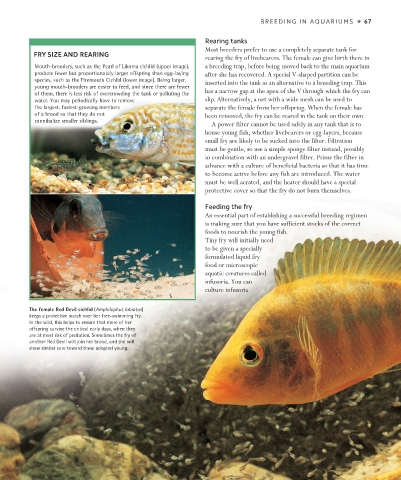
         The female Red Devil cichlid (Amphilophus labiatus)
         keeps a protective watch over her free-swimming fry.
         In the wild, this helps to ensure that more of her
         offspring survive the critical early days, when they
         are at most risk of predation. Sometimes the fry of
         another Red Devil will join her brood, and she will
         show similar care toward these adopted young.


   US_064-069_Breeding_In_Aquaria.indd   67                                                          29/08/18   4:08 PM

