


Page 66 - Encyclopedia of Aquarium and Pond Fish, 3rd Edition
P. 66
64    FRESHWATER FISH: BREEDING

         Breeding in aquariums


         One of the most challenging yet rewarding aspects of
         fishkeeping is to breed your own fish. Think carefully about
         which fish you should breed and where you will house the
         spawning fish, and decide how many fry you can comfortably cope
         with and how you will feed them. Make a record of your successes
         and failures so that future breeding attempts go more smoothly.

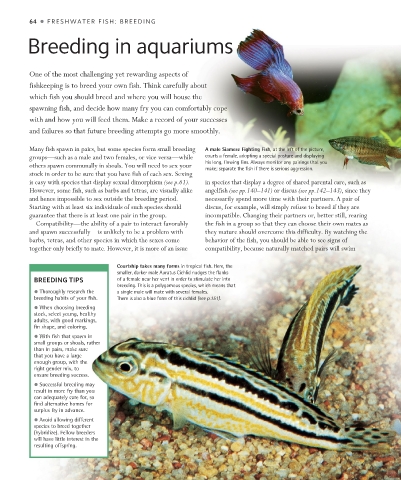
         Many fish spawn in pairs, but some species form small breeding   A male Siamese Fighting Fish, at the left of the picture,
         groups—such as a male and two females, or vice versa—while   courts a female, adopting a special posture and displaying
         others spawn communally in shoals. You will need to sex your   his long, flowing fins. Always monitor any pairings that you
                                                          make; separate the fish if there is serious aggression.
         stock in order to be sure that you have fish of each sex. Sexing
         is easy with species that display sexual dimorphism (see p.61).   in species that display a degree of shared parental care, such as
         However, some fish, such as barbs and tetras, are visually alike   angelfish (see pp.140–141) or discus (see pp.142–143), since they
         and hence impossible to sex outside the breeding period.   necessarily spend more time with their partners. A pair of
         Starting with at least six individuals of such species should   discus, for example, will simply refuse to breed if they are
         guarantee that there is at least one pair in the group.  incompatible. Changing their partners or, better still, rearing
           Compatibility—the ability of a pair to interact favorably    the fish in a group so that they can choose their own mates as
         and spawn successfully—is unlikely to be a problem with    they mature should overcome this difficulty. By watching the
         barbs, tetras, and other species in which the sexes come   behavior of the fish, you should be able to see signs of
         together only briefly to mate. However, it is more of an issue    compatibility, because naturally matched pairs will swim

                                 Courtship takes many forms in tropical fish. Here, the
                                 smaller, darker male Auratus Cichlid nudges the flanks
          BREEDING TIPS          of a female near her vent in order to stimulate her into
                                 breeding. This is a polygamous species, which means that
          •  Thoroughly research the   a single male will mate with several females.
          breeding habits of your fish.  There is also a blue form of this cichlid (see p.151).
          •  When choosing breeding
          stock, select young, healthy
          adults, with good markings,
          fin shape, and coloring.
          •  With fish that spawn in
          small groups or shoals, rather
          than in pairs, make sure
          that you have a large
          enough group, with the
          right gender mix, to
          ensure breeding success.
          •  Successful breeding may
          result in more fry than you
          can adequately care for, so
          find alternative homes for
          surplus fry in advance.
          •  Avoid allowing different
          species to breed together
          (hybridize). Fellow breeders
          will have little interest in the
          resulting offspring.


   US_064-069_Breeding_In_Aquaria.indd   64                                                          29/08/18   4:08 PM

