


Page 72 - Encyclopedia of Aquarium and Pond Fish, 3rd Edition
P. 72
70    FRESHWATER FISH: BREEDING

         Fish genetics


         As fish have been spawned in aquariums over generations,
         there has been an understandable tendency to select the
                                                           GENETIC MODIFICATION OF FISH
         most colorful individuals for breeding purposes. For this
                                                           This controversial laboratory method for developing fish with
         reason, many of the most popular tropical aquarium   unusual characteristics originated in scientific research. By
                                                           introducing the luminescence gene from a jellyfish into the genetic
         fish kept today are more brightly colored than their   makeup of fish (a standard technique used to “visualize” genes),
         wild relatives. Modern techniques have allowed the   researchers created fish in which every cell in the body emitted a
                                                           green glow. Rice Fish that carry this jellyfish gene, pictured below,
         development of varieties to be taken to new extremes,   were developed in Taiwan during 2001 as part of a medical research
                                                           program, but their commercial potential was quickly realized, and
         with the first genetically modified fish now available.  they became the first genetically modified aquarium fish available to
                                                           hobbyists. Subsequently, Zebra Danios (see p.76) that carry the
                                                           jellyfish luminescence gene have been developed at the National
         The science of genetics is concerned with the way in    University of Singapore as part of a scientific study into detecting
         which characteristics pass from one generation to the next.   environmental pollution. Trademarked as “Glofish,” they also went
         The characteristics of all living organisms, including fish,    on sale in pet stores in some parts of the US late in 2003.
         are contained in the genes, which are carried on rodlike
         structures called chromosomes, present within the nucleus
         of every living cell in the body. Mutations (or unexpected
         changes) in the genetic structure can occur and sometimes
         result in a change to the fish’s physical appearance, such as
         its color, patterning, or body and fin shape. When mutations
         occur in certain cells, such as egg or sperm cells, the change
         is passed to the next generation. Most mutations make only
         subtle changes, which can be enhanced by selective breeding
         (see opposite) over many generations. On occasions, however,
         a mutation that creates a radical change can occur. The golden
         coloration of the Butterball Angelfish (Pterophyllum sp. var.), for
         example, resulted from a mutation that caused the loss of a
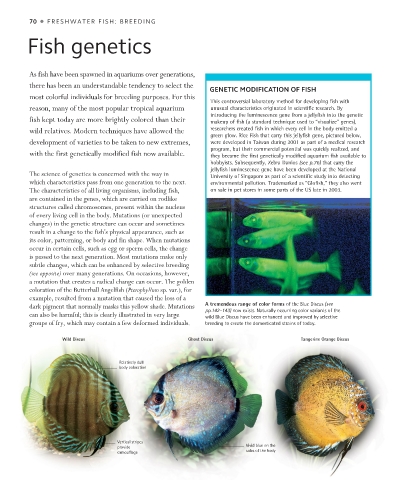
         dark pigment that normally masks this yellow shade. Mutations   A tremendous range of color forms of the Blue Discus (see
         can also be harmful; this is clearly illustrated in very large   pp.142–143) now exists. Naturally occurring color variants of the
                                                          wild Blue Discus have been enhanced and improved by selective
         groups of fry, which may contain a few deformed individuals.  breeding to create the domesticated strains of today.

                  Wild Discus                        Ghost Discus                   Tangerine Orange Discus


                                  Relatively dull
                                  body coloration


                                 Vertical stripes
                                 provide                             Vivid blue on the
                                 camouflage                          sides of the body


   US_070-071_Fish_Genetics_V1.indd   70                                                             29/08/18   4:09 PM

