


Page 67 - Encyclopedia of Aquarium and Pond Fish, 3rd Edition
P. 67
BREEDING IN AQUARIUMS     65


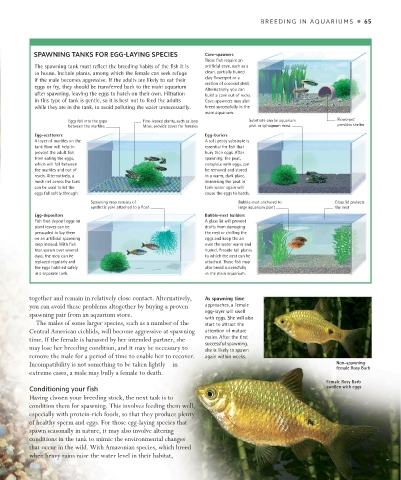
          SPAWNING TANKS FOR EGG-LAYING SPECIES           Cave-spawners
                                                          These fish require an
           The spawning tank must reflect the breeding habits of the fish it is   artificial cave, such as a
           to house. Include plants, among which the female can seek refuge   clean, partially buried
           if the male becomes aggressive. If the adults are likely to eat their   clay flowerpot or a
                                                          section of coconut shell.
           eggs or fry, they should be transferred back to the main aquarium   Alternatively, you can
           after spawning, leaving the eggs to hatch on their own. Filtration   build a cave out of rocks.
           in this type of tank is gentle, so it is best not to feed the adults   Cave-spawners may also
           while they are in the tank, to avoid polluting the water unnecessarily.  breed successfully in the
                                                          main aquarium.
                    Eggs fall into the gaps   Fine-leaved plants, such as Java   Substrate can be aquarium   Flowerpot
                    between the marbles  Moss, provide cover for females  peat or sphagnum moss  provides shelter
           Egg-scatterers                                 Egg-buriers
           A layer of marbles on the                      A soft peaty substrate is
           tank floor will help to                        essential for fish that
           prevent the adult fish                         bury their eggs. After
           from eating the eggs,                          spawning, the peat,
           which will fall between                        complete with eggs, can
           the marbles and out of                         be removed and stored
           reach. Alternatively, a                        in a warm, dark place.
           mesh net across the tank                       Immersing the peat in
           can be used to let the                         tank water again will
           eggs fall safely through.                      cause the eggs to hatch.
                          Spawning mop consists of                 Bubble-nest anchored to    Glass lid protects
                          synthetic yarn attached to a float       large aquarium plant      the nest
           Egg-depositors                                 Bubble-nest builders
           Fish that deposit eggs on                      A glass lid will prevent
           plant leaves can be                            drafts from damaging
           persuaded to lay them                          the nest or chilling the
           on an artificial spawning                      eggs and keep the air
           mop instead. With fish                         over the water warm and
           that spawn over several                        humid. Provide tall plants
           days, the mop can be                           to which the nest can be
           replaced regularly and                         attached. These fish may
           the eggs hatched safely                        also breed successfully
           in a separate tank.                            in the main aquarium.

         together and remain in relatively close contact. Alternatively,   As spawning time
         you can avoid these problems altogether by buying a proven   approaches, a female
         spawning pair from an aquarium store.            egg-layer will swell
                                                          with eggs. She will also
           The males of some larger species, such as a number of the   start to attract the
         Central American cichlids, will become aggressive at spawning   attention of mature
         time. If the female is harassed by her intended partner, she   males. After the first
         may lose her breeding condition, and it may be necessary to   successful spawning,
                                                          she is likely to spawn
         remove the male for a period of time to enable her to recover.   again within weeks.
         Incompatibility is not something to be taken lightly—in                              Non-spawning
                                                                                              female Rosy Barb
         extreme cases, a male may bully a female to death.
                                                                                           Female Rosy Barb
         Conditioning your fish                                                            swollen with eggs
         Having chosen your breeding stock, the next task is to
         condition them for spawning. This involves feeding them well,
         especially with protein-rich foods, so that they produce plenty
         of healthy sperm and eggs. For those egg-laying species that
         spawn seasonally in nature, it may also involve altering
         conditions in the tank to mimic the environmental changes
         that occur in the wild. With Amazonian species, which breed
         when heavy rains raise the water level in their habitat,


   US_064-069_Breeding_In_Aquaria.indd   65                                                          29/08/18   4:08 PM

