


Page 70 - Encyclopedia of Aquarium and Pond Fish, 3rd Edition
P. 70
68    FRESHWATER FISH: BREEDING

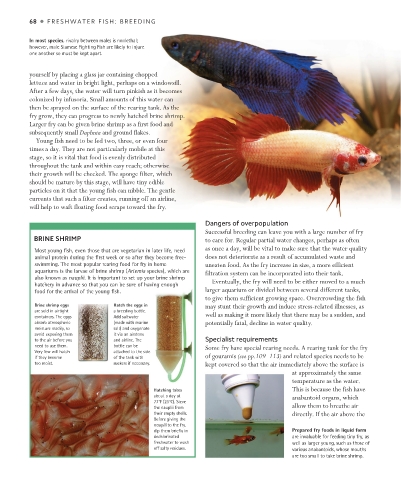
         In most species, rivalry between males is nonlethal;
         however, male Siamese Fighting Fish are likely to injure
         one another so must be kept apart.

         yourself by placing a glass jar containing chopped
         lettuce and water in bright light, perhaps on a windowsill.
         After a few days, the water will turn pinkish as it becomes
         colonized by infusoria. Small amounts of this water can
         then be sprayed on the surface of the rearing tank. As the
         fry grow, they can progress to newly hatched brine shrimp.
         Larger fry can be given brine shrimp as a first food and
         subsequently small Daphnia and ground flakes.
           Young fish need to be fed two, three, or even four
         times a day. They are not particularly mobile at this
         stage, so it is vital that food is evenly distributed
         throughout the tank and within easy reach; otherwise
         their growth will be checked. The sponge filter, which
         should be mature by this stage, will have tiny edible
         particles on it that the young fish can nibble. The gentle
         currents that such a filter creates, running off an airline,
         will help to waft floating food scraps toward the fry.

                                                          Dangers of overpopulation
                                                          Successful breeding can leave you with a large number of fry
          BRINE SHRIMP                                    to care for. Regular partial water changes, perhaps as often
           Most young fish, even those that are vegetarian in later life, need   as once a day, will be vital to make sure that the water quality
           animal protein during the first week or so after they become free-   does not deteriorate as a result of accumulated waste and
           swimming. The most popular rearing food for fry in home   uneaten food. As the fry increase in size, a more efficient
           aquariums is the larvae of brine shrimp (Artemia species), which are   filtration system can be incorporated into their tank.
           also known as nauplii. It is important to set up your brine shrimp   Eventually, the fry will need to be either moved to a much
           hatchery in advance so that you can be sure of having enough
           food for the arrival of the young fish.        larger aquarium or divided between several different tanks,
                                                          to give them sufficient growing space. Overcrowding the fish
           Brine shrimp eggs    Hatch the eggs in         may stunt their growth and induce stress-related illnesses, as
           are sold in airtight   a breeding bottle.      well as making it more likely that there may be a sudden, and
           containers. The eggs   Add saltwater
           absorb atmospheric   (made with marine         potentially fatal, decline in water quality.
           moisture readily, so   salt) and oxygenate
           avoid exposing them   it via an airstone
           to the air before you   and airline. The       Specialist requirements
           need to use them.    bottle can be             Some fry have special rearing needs. A rearing tank for the fry
           Very few will hatch    attached to the side
           if they become       of the tank with          of gouramis (see pp.109–113) and related species needs to be
           too moist.           suckers if necessary.     kept covered so that the air immediately above the surface is
                                                                                  at approximately the same
                                                                                  temperature as the water.
                                           Hatching takes                         This is because the fish have
                                           about a day at                         anabantoid organs, which
                                           77°F (25°C). Sieve
                                           the nauplii from                       allow them to breathe air
                                           their empty shells.                    directly. If the air above the
                                           Before giving the
                                           nauplii to the fry,
                                           dip them briefly in                    Prepared fry foods in liquid form
                                           dechlorinated                          are invaluable for feeding tiny fry, as
                                           freshwater to wash                     well as larger young, such as those of
                                           off salty residues.                    various anabantoids, whose mouths
                                                                                  are too small to take brine shrimp.


   US_064-069_Breeding_In_Aquaria.indd   68                                                          29/08/18   4:08 PM

