


Page 77 - Encyclopedia of Aquarium and Pond Fish, 3rd Edition
P. 77
CYPRINIDS    75


          Epalzeorhynchos bicolor         Epalzeorhynchos frenatus
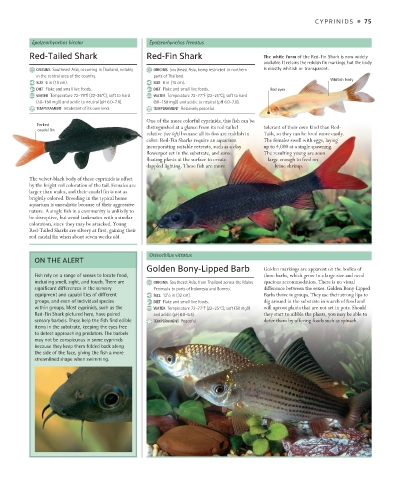
         Red-Tailed Shark                Red-Fin Shark                    The white form of the Red-Fin Shark is now widely
                                                                          available. It retains the reddish fin markings, but the body
           ORIGINS  Southeast Asia, occurring in Thailand, notably   ORIGINS  Southeast Asia, being restricted to northern   is mostly whitish or transparent.
           in the central area of the country.   parts of Thailand.                         Whitish body
           SIZE  6 in (15 cm).             SIZE  6 in (15 cm).
           DIET  Flake and small live foods.  DIET  Flake and small live foods.  Red eyes
           WATER  Temperature 72–79°F (22–26°C); soft to hard   WATER  Temperature 72–77°F (22–25°C); soft to hard
           (50–150 mg/l) and acidic to neutral (pH 6.0–7.0).  (50–150 mg/l) and acidic to neutral (pH 6.0–7.0).
           TEMPERAMENT  Intolerant of its own kind.  TEMPERAMENT  Relatively peaceful.
                                         One of the more colorful cyprinids, this fish can be
           Forked                        distinguished at a glance from its red-tailed   tolerant of their own kind than Red-
           caudal fin
                                         relative (see left) because all its fins are reddish in   Tails, so they can be bred more easily.
                                         color. Red-Fin Sharks require an aquarium   The females swell with eggs, laying
                                         incorporating suitable retreats, such as a clay   up to 4,000 at a single spawning.
                                         flowerpot set in the substrate, and some   The resulting young are soon
                                         floating plants at the surface to create   large enough to feed on
                                         dappled lighting. These fish are more   brine shrimp.
         The velvet-black body of these cyprinids is offset
         by the bright red coloration of the tail. Females are
         larger than males, and their caudal fin is not as
         brightly colored. Breeding in the typical home
         aquarium is unrealistic because of their aggressive
         nature. A single fish in a community is unlikely to
         be disruptive, but avoid tankmates with a similar
         coloration, since they may be attacked. Young
         Red-Tailed Sharks are silvery at first, gaining their
         red caudal fin when about seven weeks old.

                                          Osteochilus vittatus
           ON THE ALERT
                                         Golden Bony-Lipped Barb          Golden markings are apparent on the bodies of
           Fish rely on a range of senses to locate food,                 these barbs, which grow to a large size and need
           including smell, sight, and touch. There are   ORIGINS  Southeast Asia, from Thailand across the Malay   spacious accommodation. There is no visual
           significant differences in the sensory   Peninsula to parts of Indonesia and Borneo.  difference between the sexes. Golden Bony-Lipped
           equipment and capabilities of different   SIZE  12 ⁄2 in (32 cm).  Barbs thrive in groups. They use their strong lips to
                                               1
           groups, and even of individual species    DIET  Flake and small live foods.  dig around in the substrate in search of food and
           within groups. Most cyprinids, such as the   WATER  Temperature 72–77°F (22–25°C); soft (50 mg/l)   will uproot plants that are not set in pots. Should
           Red-Fin Shark pictured here, have paired   and acidic (pH 6.0–6.5).   they start to nibble the plants, you may be able to
           sensory barbels. These help the fish find edible   TEMPERAMENT  Peaceful.  deter them by offering foods such as spinach.
           items in the substrate, keeping the eyes free
           to detect approaching predators. The barbels
           may not be conspicuous in some cyprinids
           because they keep them folded back along
           the side of the face, giving the fish a more
           streamlined shape when swimming.


   US_074-075_Cyprinids.indd   75                                                                    29/08/18   4:09 PM

