


Page 79 - Encyclopedia of Aquarium and Pond Fish, 3rd Edition
P. 79
CYPRINIDS/DANIOS    77


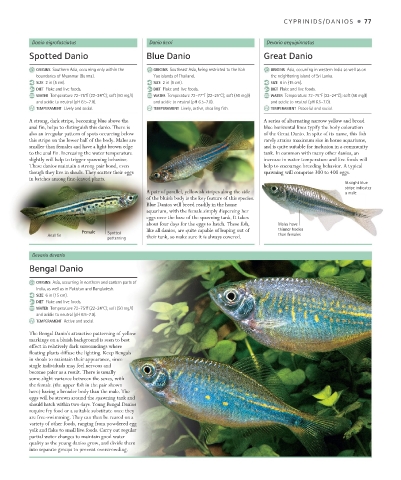
          Danio nigrofasciatus            Danio kerri                     Devario aequipinnatus
         Spotted Danio                   Blue Danio                       Great Danio

           ORIGINS  Southern Asia, occurring only within the   ORIGINS  Southeast Asia, being restricted to the Koh    ORIGINS  Asia, occurring in western India as well as on
           boundaries of Myanmar (Burma).  Yao islands of Thailand.         the neighboring island of Sri Lanka.
           SIZE  2 in (5 cm).              SIZE  2 in (5 cm).               SIZE  6 in (15 cm).
           DIET  Flake and live foods.     DIET  Flake and live foods.      DIET  Flake and live foods.
           WATER  Temperature 72–75°F (22–24°C); soft (50 mg/l)   WATER  Temperature 72–77°F (22–25°C); soft (50 mg/l)   WATER  Temperature 72–75°F (22–24°C); soft (50 mg/l)
           and acidic to neutral (pH 6.5–7.0).   and acidic to neutral (pH 6.5–7.0).   and acidic to neutral (pH 6.5–7.0).
           TEMPERAMENT  Lively and social.  TEMPERAMENT  Lively, active, shoaling fish.  TEMPERAMENT  Peaceful and social.
         A strong, dark stripe, becoming blue above the                   A series of alternating narrow yellow and broad
         anal fin, helps to distinguish this danio. There is              blue horizontal lines typify the body coloration
         also an irregular pattern of spots occurring below               of the Great Danio. In spite of its name, this fish
         this stripe on the lower half of the body. Males are             rarely attains maximum size in home aquariums,
         smaller than females and have a light brown edge                 and is quite suitable for inclusion in a community
         to the anal fin. Increasing the water temperature                tank. In common with many other danios, an
         slightly will help to trigger spawning behavior.                 increase in water temperature and live foods will
         These danios maintain a strong pair bond, even                   help to encourage breeding behavior. A typical
         though they live in shoals. They scatter their eggs              spawning will comprise 300 to 400 eggs.
         in batches among fine-leaved plants.
                                                                                                Straight blue
                                                                                                stripe indicates
                                         A pair of parallel, yellowish stripes along the side   a male
                                         of the bluish body is the key feature of this species.
                                         Blue Danios will breed readily in the home
                                         aquarium, with the female simply dispersing her
                                         eggs over the base of the spawning tank. It takes
                                         about four days for the eggs to hatch. These fish,   Males have
                        Female  Spotted   like all danios, are quite capable of leaping out of   thinner bodies
              Anal fin                                                        than females
                               patterning  their tank, so make sure it is always covered.
          Devario devario
         Bengal Danio

           ORIGINS  Asia, occurring in northern and eastern parts of
           India, as well as in Pakistan and Bangladesh.
           SIZE  6 in (15 cm).
           DIET  Flake and live foods.
           WATER  Temperature 72–75°F (22–24°C); soft (50 mg/l)
           and acidic to neutral (pH 6.5–7.0).
           TEMPERAMENT  Active and social.
         The Bengal Danio’s attractive patterning of yellow
         markings on a bluish background is seen to best
         effect in relatively dark surroundings where
         floating plants diffuse the lighting. Keep Bengals
         in shoals to maintain their appearance, since
         single individuals may feel nervous and
         become paler as a result. There is usually
         some slight variance between the sexes, with
         the female (the upper fish in the pair shown
         here) having a broader body than the male. The
         eggs will be strewn around the spawning tank and
         should hatch within two days. Young Bengal Danios
         require fry food or a suitable substitute once they
         are free-swimming. They can then be reared on a
         variety of other foods, ranging from powdered egg
         yolk and flake to small live foods. Carry out regular
         partial water changes to maintain good water
         quality as the young danios grow, and divide them
         into separate groups to prevent overcrowding.


   US_076-077_Danios.indd   77                                                                       29/08/18   4:09 PM

