


Page 78 - Encyclopedia of Aquarium and Pond Fish, 3rd Edition
P. 78
76    FRESHWATER FISH DIRECTORY


          Danio rerio
         Zebra Danio                     individuals, with the blue stripes sometimes being   Striped patterning
                                                                         still evident
                                         broken into streaks and spots. Few fish are more
           ORIGINS  Asia, occurring in eastern India, where it ranges   devoted to their mates than Zebras. Whiteworm
           from Kolkata to Masulipatam.  is a good conditioning food for spawning purposes,
           SIZE  2 ⁄2 in (6 cm).         with males becoming more brightly colored at this
              1
           DIET  Flake and live foods.   time and the females swelling with eggs. The water
           WATER  Temperature 68–75°F (20–24°C); soft (50 mg/l)   in a spawning tank for danios must be about 6 in   Golden Zebra Danio  This is one of the most popular
           and acidic (pH 6.0–6.5).      (15 cm) deep. Placing a grid on the bottom will   color variants now established, having a more yellowish
           TEMPERAMENT  Lively, shoaling fish.  prevent the pair from eating their spawn. Egg-  appearance than the normal variety.
                                         laying occurs in the morning, triggered partly by    Patterning across
         These small danios show well in shoals as part of a   sunlight falling on the tank. The adults should then   Slim body  the tail
         community aquarium. The basic body patterning of   be removed. The young Zebras emerge two days
         horizontal blue and cream stripes varies between   later and are free-swimming in another five days.

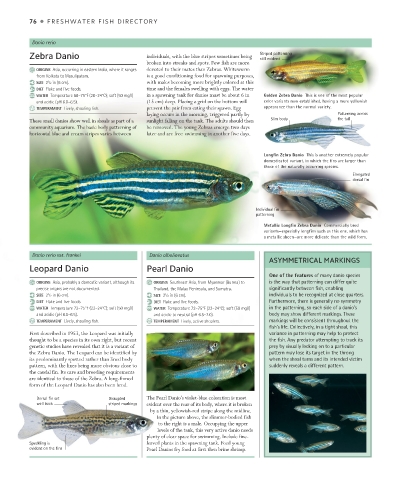
                                                                          Longfin Zebra Danio  This is another extremely popular
                                                                          domesticated variant, in which the fins are larger than
                                                                          those of the naturally occurring species.
                                                                                                  Elongated
                                                                                                  dorsal fin


                                                                        Individual fin
                                                                        patterning
                                                                          Metallic Longfin Zebra Danio  Commercially bred
                                                                          variants—especially longfins such as this one, which has
                                                                          a metallic sheen—are more delicate than the wild form.

          Danio rerio var. frankei        Danio albolineatus
                                                                           ASYMMETRICAL MARKINGS
         Leopard Danio                   Pearl Danio
                                                                           One of the features of many danio species
           ORIGINS  Asia, probably a domestic variant, although its   ORIGINS  Southeast Asia, from Myanmar (Burma) to   is the way that patterning can differ quite
           precise origins are not documented.  Thailand, the Malay Peninsula, and Sumatra.  significantly between fish, enabling
           SIZE  2 ⁄2 in (6 cm).           SIZE  2 ⁄2 in (6 cm).           individuals to be recognized at close quarters.
              1
                                               1
           DIET  Flake and live foods.     DIET  Flake and live foods.     Furthermore, there is generally no symmetry
           WATER  Temperature 72–75°F (22–24°C); soft (50 mg/l)   WATER  Temperature 72–75°F (22–24°C); soft (50 mg/l)   in the patterning, so each side of a danio’s
           and acidic (pH 6.0–6.5).        and acidic to neutral (pH 6.5–7.0).  body may show different markings. These
           TEMPERAMENT  Lively, shoaling fish.  TEMPERAMENT  Lively, active shoalers.  markings will be consistent throughout the
                                                                           fish’s life. Collectively, in a tight shoal, this
         First described in 1953, the Leopard was initially                variance in patterning may help to protect
         thought to be a species in its own right, but recent              the fish. Any predator attempting to track its
         genetic studies have revealed that it is a variant of             prey by visually locking on to a particular
         the Zebra Danio. The Leopard can be identified by                 pattern may lose its target in the throng
         its predominantly spotted rather than lined body                  when the shoal turns and its intended victim
         pattern, with the lines being more obvious close to               suddenly reveals a different pattern.
         the caudal fin. Its care and breeding requirements
         are identical to those of the Zebra. A long-finned
         form of the Leopard Danio has also been bred.
           Dorsal fin set      Disrupted   The Pearl Danio’s violet-blue coloration is most
           well back           striped markings  evident over the rear of its body, where it is broken
                                          by a thin, yellowish-red stripe along the midline.
                                            In the picture above, the slimmer-bodied fish
                                             to the right is a male. Occupying the upper
                                            levels of the tank, this very active danio needs
                                         plenty of clear space for swimming. Include fine-
         Speckling is                    leaved plants in the spawning tank. Feed young
         evident on the fins             Pearl Danios fry food at first then brine shrimp.


   US_076-077_Danios.indd   76                                                                       29/08/18   4:09 PM

