


Page 81 - Encyclopedia of Aquarium and Pond Fish, 3rd Edition
P. 81
CYPRINIDS/RASBORAS     79


          Rasboroides vaterifloris
         Orange-Finned Rasbora

           ORIGINS  Southern Asia, restricted to the island
           of Sri Lanka.
           SIZE  1 ⁄2 in (4 cm).
              1
           DIET  Live foods, plus flake.
           WATER  Temperature 77–84°F (25–29°C); soft (50 mg/l)
           and acidic (pH 6.0–6.5).
           TEMPERAMENT  Peaceful.
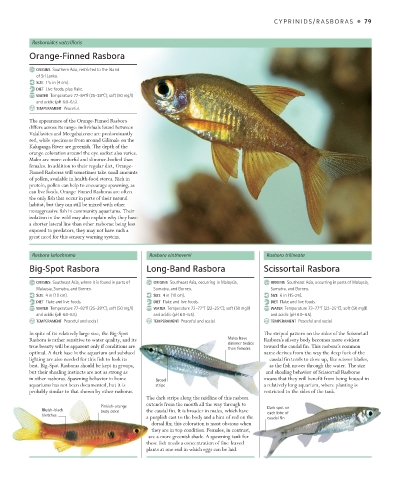
         The appearance of the Orange-Finned Rasbora
         differs across its range: individuals found between
         Valallavites and Meegahatenne are predominantly
         red, while specimens from around Gilimale on the
         Kaluganga River are greenish. The depth of the
         orange coloration around the eye socket also varies.
         Males are more colorful and slimmer-bodied than
         females. In addition to their regular diet, Orange-
         Finned Rasboras will sometimes take small amounts
         of pollen, available in health-food stores. Rich in
         protein, pollen can help to encourage spawning, as
         can live foods. Orange-Finned Rasboras are often
         the only fish that occur in parts of their natural
         habitat, but they can still be mixed with other
         nonaggressive fish in community aquariums. Their
         isolation in the wild may also explain why they have
         a shorter lateral line than other rasboras: being less
         exposed to predators, they may not have such a
         great need for this sensory warning system.

          Rasbora kalochroma              Rasbora einthovenii             Rasbora trilineata
         Big-Spot Rasbora                Long-Band Rasbora                Scissortail Rasbora

           ORIGINS  Southeast Asia, where it is found in parts of   ORIGINS  Southeast Asia, occurring in Malaysia,   ORIGINS  Southeast Asia, occurring in parts of Malaysia,
           Malaysia, Sumatra, and Borneo.   Sumatra, and Borneo.            Sumatra, and Borneo.
           SIZE  4 in (10 cm).             SIZE  4 in (10 cm).              SIZE  6 in (15 cm).
           DIET  Flake and live foods.     DIET  Flake and live foods.      DIET  Flake and live foods.
           WATER  Temperature 77–82°F (25–28°C); soft (50 mg/l)   WATER  Temperature 72–77°F (22–25°C); soft (50 mg/l)   WATER  Temperature 73–77°F (23–25°C); soft (50 mg/l)
           and acidic (pH 6.0–6.5).        and acidic (pH 6.0–6.5).         and acidic (pH 6.0–6.5).
           TEMPERAMENT  Peaceful and social.  TEMPERAMENT  Peaceful and social.  TEMPERAMENT  Peaceful and social.
         In spite of its relatively large size, the Big-Spot              The striped pattern on the sides of the Scissortail
         Rasbora is rather sensitive to water quality, and its   Males have   Rasbora’s silvery body becomes more evident
                                                                slimmer bodies
         true beauty will be apparent only if conditions are    than females  toward the caudal fin. This rasbora’s common
         optimal. A dark base in the aquarium and subdued                 name derives from the way the deep fork of the
         lighting are also needed for this fish to look its                caudal fin tends to close up, like scissor blades,
         best. Big-Spot Rasboras should be kept in groups,                 as the fish moves through the water. The size
         but their shoaling instincts are not as strong as                and shoaling behavior of Scissortail Rasboras
         in other rasboras. Spawning behavior in home   Broad             means that they will benefit from being housed in
         aquariums has not been documented, but it is   stripe            a relatively long aquarium, where planting is
         probably similar to that shown by other rasboras.                restricted to the sides of the tank.
                                         The dark stripe along the midline of this rasbora
                             Pinkish-orange    extends from the mouth all the way through to    Dark spot on
             Bluish-black    body color  the caudal fin. It is broader in males, which have
             blotches                    a purplish cast to the body and a hint of red on the   each lobe of
                                                                           caudal fin
                                           dorsal fin; this coloration is most obvious when
                                           they are in top condition. Females, in contrast,
                                          are a more greenish shade. A spawning tank for
                                         these fish needs a concentration of fine-leaved
                                         plants at one end in which eggs can be laid.


   US_078-079_Rasboras.indd   79                                                                    14/09/18   12:07 PM

