


Page 82 - Encyclopedia of Aquarium and Pond Fish, 3rd Edition
P. 82
80    FRESHWATER FISH DIRECTORY


          Rasbora borapetensis            Rasbora elegans
                                                                           RASBORA JAW STRUCTURE
         False Magnificent Rasbora       Elegant Rasbora
                                                                           Many cyprinids have downward-pointing
           ORIGINS  Southeast Asia, found in parts of    ORIGINS  Southeast Asia, on the Malay Peninsula, and   mouthparts adapted for feeding on the
            Thailand and western Malaysia.  southward to Sumatra and Borneo.  substrate. Rasboras are not substrate feeders,
           SIZE  2 in (5 cm).              SIZE  8 in (20 cm).             however, but quick, agile, sharp-eyed
           DIET  Flake and live foods.     DIET  Flake and live foods.     predators that seek their food in the middle
           WATER  Temperature 72–79°F (22–26°C); soft (50 mg/l)   WATER  Temperature 72–77°F (22–25°C); soft (50 mg/l)   and upper layers of the water. As a result,
           and acidic (pH 6.0–6.5).        and acidic (pH 6.0–6.5).        their lower jaw curves up, rather than down,
           TEMPERAMENT  Peaceful and social.  TEMPERAMENT  Peaceful and social.  as seen here on this Narrow-Wedge Harlequin
                                                                           (see opposite). This jaw structure makes it
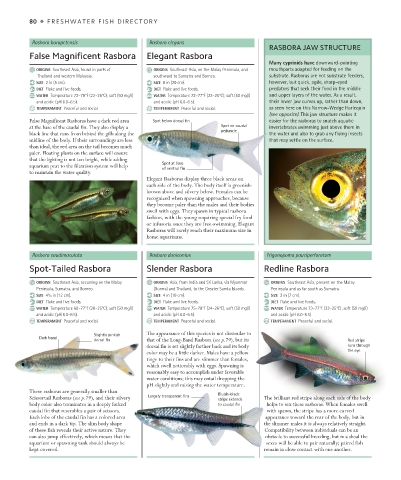
         False Magnificent Rasboras have a dark red area    Spot below dorsal fin  easier for the rasboras to snatch aquatic
         at the base of the caudal fin. They also display a   Spot on caudal   invertebrates swimming just above them in
         black line that runs from behind the gills along the   peduncle   the water and also to grab any flying insects
         midline of the body. If their surroundings are less               that may settle on the surface.
         than ideal, the red area on the tail becomes much
         paler. Floating plants on the surface will ensure
         that the lighting is not too bright, while adding
         aquarium peat to the filtration system will help    Spot at base
                                              of ventral fin
         to maintain the water quality.
                                         Elegant Rasboras display three black areas on
                                         each side of the body. The body itself is greenish-
                                         brown above and silvery below. Females can be
                                         recognized when spawning approaches, because
                                         they become paler than the males and their bodies
                                         swell with eggs. They spawn in typical rasbora
                                         fashion, with the young requiring special fry food
                                         or infusoria once they are free-swimming. Elegant
                                         Rasboras will rarely reach their maximum size in
                                         home aquariums.

          Rasbora caudimaculata           Rasbora daniconius              Trigonopoma pauciperforatum
         Spot-Tailed Rasbora             Slender Rasbora                  Redline Rasbora

           ORIGINS  Southeast Asia, occurring on the Malay   ORIGINS  Asia, from India and Sri Lanka, via Myanmar   ORIGINS  Southeast Asia, present on the Malay
           Peninsula, Sumatra, and Borneo.  (Burma) and Thailand, to the Greater Sunda Islands.  Peninsula and as far south as Sumatra.
           SIZE  4 ⁄4 in (12 cm).          SIZE  4 in (10 cm).              SIZE  3 in (7 cm).
              3
           DIET  Flake and live foods.     DIET  Flake and live foods.      DIET  Flake and live foods.
           WATER  Temperature 68–77°F (20–25°C); soft (50 mg/l)   WATER  Temperature 75–79°F (24–26°C); soft (50 mg/l)   WATER  Temperature 73–77°F (23–25°C); soft (50 mg/l)
           and acidic (pH 6.0–6.5).        and acidic (pH 6.0–6.5).         and acidic (pH 6.0–6.5).
           TEMPERAMENT  Peaceful and social.  TEMPERAMENT  Peaceful and social.  TEMPERAMENT  Peaceful and social.
                           Slightly pinkish   The appearance of this species is not dissimilar to
            Dark band      dorsal fin    that of the Long-Band Rasbora (see p.79), but its       Red stripe
                                         dorsal fin is set slightly farther back and its body    runs through
                                         color may be a little darker. Males have a yellow       the eye
                                         tinge to their fins and are slimmer than females,
                                         which swell noticeably with eggs. Spawning is
                                         reasonably easy to accomplish under favorable
                                         water conditions; this may entail dropping the
                                         pH slightly and raising the water temperature.
         These rasboras are generally smaller than           Bluish-black
         Scissortail Rasboras (see p.79), and their silvery   Largely transparent fins  stripe extends    The brilliant red stripe along each side of the body
         body color also terminates in a deeply forked       to caudal fin  helps to sex these rasboras. When females swell
         caudal fin that resembles a pair of scissors.                     with spawn, the stripe has a more curved
         Each lobe of the caudal fin has a colored area                   appearance toward the rear of the body, but in
         and ends in a dark tip. The slim body shape                      the slimmer males it is always relatively straight.
         of these fish reveals their active nature. They                  Compatibility between individuals can be an
         can also jump effectively, which means that the                  obstacle to successful breeding, but in a shoal the
         aquarium or spawning tank should always be                       sexes will be able to pair naturally; paired fish
         kept covered.                                                    remain in close contact with one another.


   US_080-081_Rasboras_2.indd   80                                                                   29/08/18   4:09 PM

