


Page 80 - Encyclopedia of Aquarium and Pond Fish, 3rd Edition
P. 80
78    FRESHWATER FISH DIRECTORY


          Boraras maculatus                                               Sundadamo axelrodi
         Spotted Rasbora                 with three dark spots along the side of the body.   Axelrod’s Rasbora
                                         The pattern of dark markings differs between
           ORIGINS  Southeast Asia, extending from western   individuals. The males are recognizable by their   ORIGINS  Southeast Asia, where this species is restricted
           Malaysia southward to western Sumatra.   brighter coloration and flat underparts; females   to the Indonesian island of Sumatra.
           SIZE  1 in (2.5 cm).          have a slightly curved lower outline. Spotted   SIZE  1 ⁄4 in (3 cm).
                                                                               1
           DIET  Flake and live foods.   Rasboras, which look best in shoals, can be mixed   DIET  Flake and live foods.
           WATER  Temperature 75–79°F (24–26°C); soft (50 mg/l)   with suitable companions of a similar size,   WATER  Temperature 73–79°F (23–26°C); soft (50 mg/l)
           and acidic (pH 6.0–6.5).      including other small rasboras. A pair will spawn    and acidic (pH 6.0–6.5).
           TEMPERAMENT  Peaceful and social.  in a breeding tank that is well planted with   TEMPERAMENT  Peaceful and social.
                                         Sagittaria and cryptocorynes, but they will eat
         This rasbora is the smallest member not only of its   their eggs if left there. About 50 eggs are produced,   These beautiful fish are instantly recognizable,
         group but also of the entire cyprinid family. The   and they hatch in about 36 hours. Very fine fry   since their body is fluorescent green on top and
         Spotted Rasbora has a long, narrow caudal peduncle   food is essential for the young fish at first.  reddish below, with red coloration also evident
                                                                          on the ventral fin. Axelrod’s Rasboras appear to
                                                                          lack the sensory lateral line along the sides
                                                                          of the body, which is perhaps compensated for by
                                                                          their large eyes. Discovered in 1976, this species
                                                                          was named after Dr. Herbert Axelrod, a leading
                                                                          American ichthyologist and fishkeeper.


          Boraras urophthalmoides
                                                                           GROUP DYNAMICS
         Glass Rasbora                   peduncle. Male Glass Rasboras have a very
                                         evident white spot at the base of the dorsal fin    The majority of rasboras are shoaling fish,
           ORIGINS  Southeast Asia, where its distribution extends   and a larger adjacent black area, both of which    and if they are kept singly in the aquarium,
           from Vietnam south to Sumatra.  the females lack. Relatively dark surroundings,   they become shy and nervous. There appears
           SIZE  1 ⁄2 in (3.5 cm).       with bogwood decor and suitable plants, should   to be some recognition between members
              1
           DIET  Flake and live foods.   help to overcome the natural nervousness of these   of a shoal, since new individuals added to an
           WATER  Temperature 73–77°F (23–25°C); soft (50 mg/l)   fish. It has proved possible to breed Glass    aquarium containing an established group are
           and acidic (pH 6.0–6.5).      Rasboras in a planted spawning tank, provided    unlikely to be accepted readily by the rest of
           TEMPERAMENT  Peaceful and social.  that the water temperature is kept slightly higher   the shoal. As a result, the newcomers may
                                         than that in the main aquarium, at up to 82°F   form a separate group, but there is rarely any
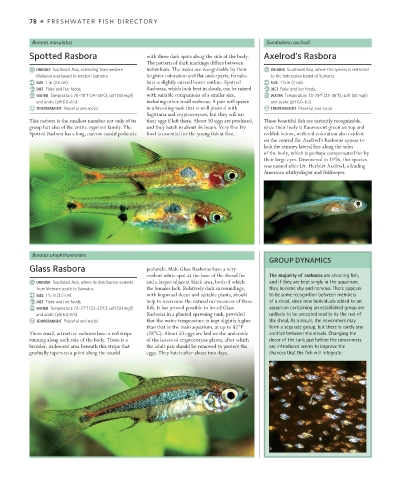
         These small, attractive rasboras have a red stripe   (28°C). About 50 eggs are laid on the underside    conflict between the shoals. Changing the
         running along each side of the body. There is a   of the leaves of cryptocoryne plants, after which   decor of the tank just before the newcomers
         broader, iridescent area beneath this stripe that   the adult pair should be removed to protect the   are introduced seems to improve the
         gradually tapers to a point along the caudal   eggs. They hatch after about two days.  chances that the fish will integrate.


   US_078-079_Rasboras.indd   78                                                                     29/08/18   4:09 PM

