


Page 83 - Encyclopedia of Aquarium and Pond Fish, 3rd Edition
P. 83
CYPRINIDS/RASBORAS     81


          Trigonostigma espei
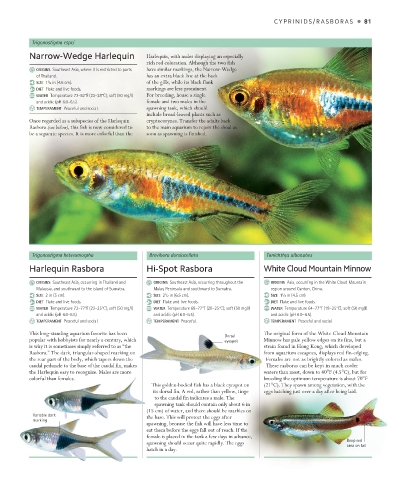
         Narrow-Wedge Harlequin          Harlequin, with males displaying an especially
                                         rich red coloration. Although the two fish
           ORIGINS  Southeast Asia, where it is restricted to parts    have similar markings, the Narrow-Wedge
           of Thailand.                  has an extra black line at the back
           SIZE  1 ⁄4 in (4.5 cm).       of the gills, while its black flank
              3
           DIET  Flake and live foods.   markings are less prominent.
           WATER  Temperature 73–82°F (23–28°C); soft (50 mg/l)   For breeding, house a single
           and acidic (pH 6.0–6.5).      female and two males in the
           TEMPERAMENT  Peaceful and social.  spawning tank, which should
                                         include broad-leaved plants such as
         Once regarded as a subspecies of the Harlequin   cryptocorynes. Transfer the adults back
         Rasbora (see below), this fish is now considered to   to the main aquarium to rejoin the shoal as
         be a separate species. It is more colorful than the   soon as spawning is finished.


          Trigonostigma heteromorpha      Brevibora dorsiocellata         Tanichthys albonubes
         Harlequin Rasbora               Hi-Spot Rasbora                  White Cloud Mountain Minnow

           ORIGINS  Southeast Asia, occurring in Thailand and   ORIGINS  Southeast Asia, occurring throughout the   ORIGINS  Asia, occurring in the White Cloud Mountain
           Malaysia, and southward to the island of Sumatra.  Malay Peninsula and southward to Sumatra.  region around Canton, China.
           SIZE  2 in (5 cm).              SIZE  2 ⁄2 in (6.5 cm).          SIZE  1 ⁄4 in (4.5 cm).
                                               1
                                                                               1
           DIET  Flake and live foods.     DIET  Flake and live foods.      DIET  Flake and live foods.
           WATER  Temperature 73–77°F (23–25°C); soft (50 mg/l)   WATER  Temperature 68–77°F (20–25°C); soft (50 mg/l)   WATER  Temperature 64–77°F (18–25°C); soft (50 mg/l)
           and acidic (pH 6.0 –6.5).       and acidic (pH 6.0  –6.5).       and acidic (pH 6.0–6.5).
           TEMPERAMENT  Peaceful and social.  TEMPERAMENT  Peaceful.        TEMPERAMENT  Peaceful and social.
         This long-standing aquarium favorite has been         Dorsal     The original form of the White Cloud Mountain
         popular with hobbyists for nearly a century, which    eyespot    Minnow has pale yellow edges on its fins, but a
         is why it is sometimes simply referred to as “the                strain found in Hong Kong, which developed
         Rasbora.” The dark, triangular-shaped marking on                 from aquarium escapees, displays red fin-edging.
         the rear part of the body, which tapers down the                 Females are not as brightly colored as males.
         caudal peduncle to the base of the caudal fin, makes             These rasboras can be kept in much cooler
         the Harlequin easy to recognize. Males are more                  waters than most, down to 40°F (4.5°C), but for
         colorful than females.                                           breeding the optimum temperature is about 70°F
                                           This golden-bodied fish has a black eyespot on   (21°C). They spawn among vegetation, with the
                                           its dorsal fin. A red, rather than yellow, tinge   eggs hatching just over a day after being laid.
                                            to the caudal fin indicates a male. The
                                            spawning tank should contain only about 6 in
                                         (15 cm) of water, and there should be marbles on
          Variable dark                  the base. This will protect the eggs after
          marking
                                         spawning, because the fish will have less time to
                                         eat them before the eggs fall out of reach. If the
                                         female is placed in the tank a few days in advance,
                                         spawning should occur quite rapidly. The eggs           Deep red
                                                                                                 area on tail
                                         hatch in a day.


   US_080-081_Rasboras_2.indd   81                                                                   29/08/18   4:09 PM

