


Page 204 - Atlas Of The World's Strangest Animals
P. 204
204      ATLAS  OF THE WORLD’S  STRANGEST ANIMALS


           To humans, the ocean can be as challenging and hostile as  muscular structure that houses their gills, stomach,
           outer space itself.The area covered by our planets’ great  reproductive organs – and hearts.
           global ocean is vast. Much of this is totally unexplored, but  Yes, hearts: octopi have three! Humans, like most
           even in its upper regions, life is as strange and as alien as  mammals, have red blood because the protein that binds
           anything we might discover on other planets.           oxygen (haemoglobin) contains iron. The blood of octopi
             Octopi belong to a group of invertebrates known as   is blue because their oxygen-binding protein comes from
           cephalopods and they are one of the ocean’s great oddities.  hemocyanin, which is copper-based.This is a poor binder,
           The word cephalopod means ‘head-footed’, referring to  so to cope with low oxygen levels in their blood, the
           the the way that the arms of the octopus attach directly to  octopi need three hearts.These help to maintain a
           its head. Cephalopods, like molluscs, have an exterior shell  constant, high blood pressure.
           while cephalods, like cuttlefish, have a small, residual  The octopus’ most alien feature, however, is undoubtedly
           skeleton. By contrast, the bodies of octopi contain neither  its famous arms.These long, flexible structures are their
           of these protective structures. Instead their soft, internal  main way of interacting with their environment and are
           organs are defended by a mantle – an extraordinary,    used for everything from hunting to feeding, mating to


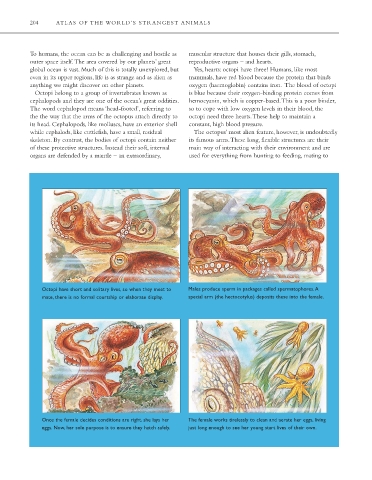
                Octopi have short and solitary lives, so when they meet to  Males produce sperm in packages called spermatophores.A
                mate, there is no formal courtship or elaborate display.  special arm (the hectocotylus) deposits these into the female.


                Once the female decides conditions are right, she lays her  The female works tirelessly to clean and aerate her eggs, living
                eggs. Now, her sole purpose is to ensure they hatch safely.  just long enough to see her young start lives of their own.


                                             (c) 2011 Marshall Cavendish. All Rights Reserved.

