


Page 205 - Atlas Of The World's Strangest Animals
P. 205
COMMON OCTOPUS               205


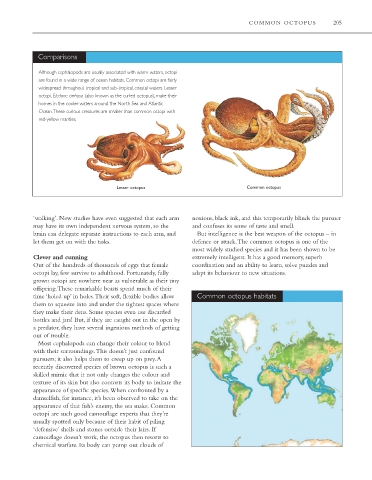
              Comparisons

              Although cephalopods are usually associated with warm waters, octopi
              are found in a wide range of ocean habitats. Common octopi are fairly
              widespread throughout tropical and sub-tropical, coastal waters. Lesser
              octopi, Eledone cirrhosa (also known as the curled octopus), make their
              homes in the cooler waters around the North Sea and Atlantic
              Ocean.These curious creatures are smaller than common octopi with
              red-yellow mantles.


                                         Lesser octopus                               Common octopus


             ‘walking’. New studies have even suggested that each arm  noxious, black ink, and this temporarily blinds the pursuer
             may have its own independent nervous system, so the    and confuses its sense of taste and smell.
             brain can delegate separate instructions to each arm, and  But intelligence is the best weapon of the octopus – in
             let them get on with the tasks.                        defence or attack.The common octopus is one of the
                                                                    most widely studied species and it has been shown to be
             Clever and cunning                                     extremely intelligent. It has a good memory, superb
             Out of the hundreds of thousands of eggs that female   coordination and an ability to learn, solve puzzles and
             octopi lay, few survive to adulthood. Fortunately, fully  adapt its behaviour to new situations.
             grown octopi are nowhere near as vulnerable as their tiny
             offspring.These remarkable beasts spend much of their
             time ‘holed up’ in holes.Their soft, flexible bodies allow  Common octopus habitats
             them to squeeze into and under the tightest spaces where
             they make their dens. Some species even use discarded
             bottles and jars! But, if they are caught out in the open by
             a predator, they have several ingenious methods of getting
             out of trouble.
              Most cephalopods can change their colour to blend
             with their surroundings.This doesn’t just confound
             pursuers; it also helps them to creep up on prey.A
             recently discovered species of brown octopus is such a
             skilled mimic that it not only changes the colour and
             texture of its skin but also contorts its body to imitate the
             appearance of specific species.When confronted by a
             damselfish, for instance, it’s been observed to take on the
             appearance of that fish’s enemy, the sea snake. Common
             octopi are such good camouflage experts that they’re
             usually spotted only because of their habit of piling
             ‘defensive’ shells and stones outside their lairs. If
             camouflage doesn’t work, the octopus then resorts to
             chemical warfare. Its body can pump out clouds of


                                             (c) 2011 Marshall Cavendish. All Rights Reserved.

