


Page 128 - The Book of Caterpillars: A Life-Size Guide to Six Hundred Species From Around the World
P. 128
BUTTERFLY CATERPILLARS
FAMILY Pieridae
DISTRIBUTION Africa, south and Southeast Asia, and Australia
HABITAT Gardens, parks, grassland, scrub, and open forest
HOST PLANTS Silk plant (Albizia spp.), leadtree (Leucaena spp.), Senna spp.,
and other members of Fabaceae
NOTE Green caterpillar that rests well camouflaged on many plants
CONSERVATION STATUS Not evaluated
ADULT WINGSPAN
1⁄ in (40 mm)
CATERPILLAR LENGTH
1–1⁄ in (25–30 mm)
EUREMA HECABE
COMMON GRASS YELLOW
126
(LINNAEUS, 1758)
Common Grass Yellow caterpillars hatch from spindle-shaped
eggs laid singly several days earlier on the upper side of leaves
of the host plant. The newly emerged caterpillars consume the
eggshell first before moving on to the leaves. The young larvae
are green and covered in tiny tubercles. As they develop, the
larvae rest alongside the midrib of leaves, which action provides
excellent camouflage. The pupa is found hanging from the stem
Actual size
of the host plant.
Although it prefers grassy habitats, this species does not feed on
grass, and its common name is more likely to have been derived
from the way the butterfly adult fl ies slowly, staying close to
the ground. The Common Grass Yellow is also widespread,
as its name suggests, and a migrant species that occurs in many
different habitats due to the distribution of its host plants. There
are about 18 subspecies.
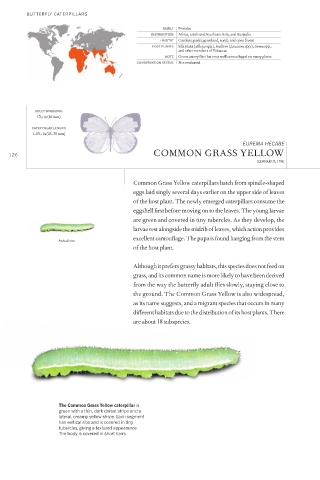
The Common Grass Yellow caterpillar is
green with a thin, dark dorsal stripe and a
lateral, creamy yellow stripe. Each segment
has vertical ribs and is covered in tiny
tubercles, giving a textured appearance.
The body is covered in short hairs.

