


Page 125 - The Book of Caterpillars: A Life-Size Guide to Six Hundred Species From Around the World
P. 125
BUTTERFLY CATERPILLARS
FAMILY Pieridae
DISTRIBUTION Northern and eastern Australia, southeastern New Guinea
HABITAT Savannahs and paperbark woodlands
HOST PLANTS Mistletoe (Amyema spp., Decaisnina spp., Dendrophthoe spp.,
and Muellerina spp.)
NOTE Gregarious caterpillar that sometimes defoliates the food plant
CONSERVATION STATUS Not evaluated, but common in tropical and subtropical regions
ADULT WINGSPAN
2⁄ in (62 mm)
CATERPILLAR LENGTH
1⁄ in (40 mm)
DELIAS ARGENTHONA
SCARLET JEZEBEL 123
(FABRICIUS, 1793)
Scarlet Jezebel caterpillars hatch from eggs laid in closely
packed, irregular groups of up to 50 on young leaves and
stems of the mistletoe host plant. The larvae first devour their
eggshells, then consume the young soft growth. Later instars
feed on older leaves. They develop synchronously and can cause Actual size
defoliation of small mistletoe plants. Growth is completed in
three to four weeks, and there are several generations annually.
The caterpillars often pupate together on the mistletoe but also
singly on the mistletoe or nearby on the host tree. The pupa
is attached to a silken pad by the cremaster and a silk girdle.
In the northern areas of the species’ range, breeding occurs in
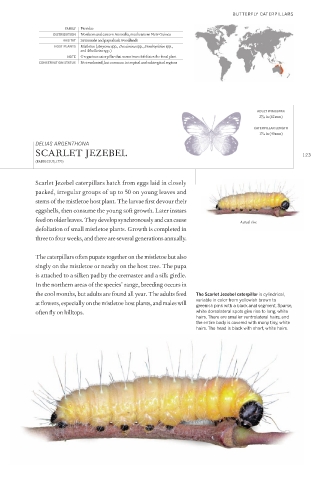
the cool months, but adults are found all year. The adults feed The Scarlet Jezebel caterpillar is cylindrical,
at flowers, especially on the mistletoe host plants, and males will variable in color from yellowish brown to
greenish pink with a black anal segment. Sparse,
often fly on hilltops. white dorsolateral spots give rise to long, white
hairs. There are smaller ventrolateral hairs, and
the entire body is covered with many tiny, white
hairs. The head is black with short, white hairs.

