


Page 129 - The Book of Caterpillars: A Life-Size Guide to Six Hundred Species From Around the World
P. 129
BUTTERFLY CATERPILLARS

                      FAMILY  Pieridae
                  DISTRIBUTION  Europe, North Africa, across the Middle East and northern Asia
                     HABITAT  Various, including grassland, woodlands, parks, and gardens
                  HOST PLANTS  Alder Buckthorn (Frangula alnus) and Buckthorn
                           (Rhamnus cathartica)

                      NOTE  Pale green caterpillar that is well camouflaged among leaves
             CONSERVATION STATUS  Not evaluated, but widespread and common


                                                                                   ADULT WINGSPAN
                                                                                  2⅜–2¹⁵∕₁₆ in (60–74 mm)
                                                                                  CATERPILLAR LENGTH
                                                                                    1⁵∕₁₆ in (33 mm)
            GONEPTERYX RHAMNI
            BRIMSTONE                                                                            127

            (LINNAEUS, 1758)


            Brimstone caterpillars hatch from pale, yellow-green eggs
            laid singly some 10 to 14 days earlier on the youngest leaves of
            the host plant. The young larvae move to the upperside of the
            leaf to feed. At rest, they lie along the midrib of the leaf, and
            if disturbed they raise the front half of their body. Their main
            natural enemies are birds and parasitic wasps. The larval stage
            takes about a month. When the caterpillars are ready to pupate,   Actual size
            they attach themselves to the underside of a leaf or stem by a
            silk pad and girdle.


            Like the caterpillar, the green pupa is well camouflaged, as it
            resembles a curled leaf. The emerging, long-lived butterfly feeds

            on nectar in the summer and then hibernates until early spring;

            it is often the first butterfly to be seen each year. Many claim that

            the conspicuous yellow wings of the adult Brimstone gave rise


            to the word butterfly from “butter-colored fly.”


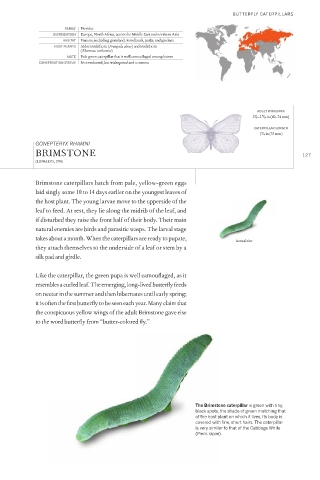
                                                               The Brimstone caterpillar is green with tiny,
                                                               black spots, the shade of green matching that
                                                               of the host plant on which it lives. Its body is
                                                               covered with   ne, short hairs. The caterpillar
                                                               is very similar to that of the Cabbage White
                                                               (Pieris rapae).

