Page 130 - The Book of Caterpillars: A Life-Size Guide to Six Hundred Species From Around the World
P. 130
BUTTERFLY CATERPILLARS

                                                     FAMILY  Pieridae
                                                 DIS
                                                 DISTRIBUTION  East Andean slopes, from Venezuela to Bolivia
                                                   TRIBUTION
                                                 DISTRIBUTION
                                                    HABIT
                                                    HABITAT T  Second growth and forest edges of humid Andean cloud forests
                                                       A
                                                    HABITAT
                                                  HOS T PLANT S  Cardamine spp.
                                                  HOST PLANTS
                                                  HOST PLANTS


                                                      NOTE
                                                      NO TE  Well-camouflaged caterpillar that it is nearly impossible to find
                                                      NOTE
                                             CONSERV A TION S T A TUS  Not evaluated, but not considered threatened
                                             CONSERVATION STATUS
                                             CONSERVATION STATUS
            ADULT WINGSPAN
           1⁄–1¾ in (40–44 mm)
           CATERPILLAR LENGTH
           ⁄–1⁄ in (24–30 mm)
                                                                          LEPTOPHOBIA ELEONE
                                                              SILKY WANDERER
    128
                                                                                  (DOUBLEDAY, 1847)


                                            The slow-moving caterpillars of the Silky Wanderer hatch
                                            from bright orange, cylindrical eggs laid singly on the upper
                                            side of mature host plant leaves. The well-disguised eggs are
                                            similar in size and color to the host plant seeds, which are also
                                            scattered across the upper surfaces of leaves after being thrown
                                            from their explosively opening seedpods. The larvae, too, are
                                            perfectly colored to disappear from sight while resting on the
                                            host leaves. Young larvae are found near the apex of their small,
                                            herbaceous hosts; as they grow, they feed on more mature leaves,
                                            closer to the ground.


                                            When ready to pupate, the final instars wander from their host

                                            plant, sometimes for considerable distances, and build their
                                            pupae in sheltered and well-hidden locations such as under dead
                                            leaves or branches, usually close to the ground. Silky Wanderer
                                            adults are fairly weak fliers and feed from a variety of common


                                            roadside flowers.


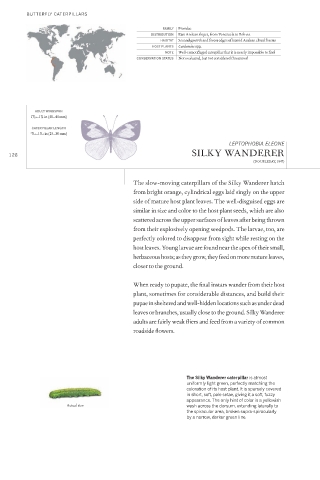
                                                             The Silky Wanderer caterpillar is almost
                                                             uniformly light green, perfectly matching the
                                                             coloration of its host plant. It is sparsely covered
                                                             in short, soft, pale setae, giving it a soft, fuzzy
                                                             appearance. The only hint of color is a yellowish
                      Actual size                            wash across the dorsum, extending laterally to
                                                             the spiracular area, broken supra-spiracularly
                                                             by a narrow, darker green line.
   125   126   127   128   129   130   131   132   133   134   135