


Page 124 - The Book of Caterpillars: A Life-Size Guide to Six Hundred Species From Around the World
P. 124
BUTTERFLY CATERPILLARS

                                                     FAMILY  Pieridae
                                                 DISTRIBUTION  North America, including Mexico

                                                    HABITAT  Montane meadows, alfalfa fields, gardens, parks, and pastures
                                                  HOST PLANTS  Legumes, including Alfalfa (Medicago sativa), clover (Trifolium
                                                          spp.), vetch (Vicia spp.), Birdsfoot Trefoil (Lotus corniculatus),
                                                          and lupine (Lupinus spp.)

                                                      NOTE  Caterpillar that can occur in millions around Alfalfa fields
                                             CONSERVATION STATUS  Not evaluated, but common


            ADULT WINGSPAN
           1¾–2 in (45–50 mm)
           CATERPILLAR LENGTH
           1³∕₈–1⁹∕₁₆ in (35–40 mm)
                                                                            COLIAS EURYTHEME
                                                             ORANGE SULPHUR
    122
                                                                                   BOISDUVAL, 1852


                                            Before the Orange Sulphur caterpillar hatches, its white, spindle-
                                            shaped egg turns yellow, then orange red. First instars consume
                                            most of the eggshell after hatching. During the early instars, the
                                            caterpillars skeletonize leaves by feeding between veins on both
                                            sides of the midrib. Later instars consume entire leaves from
                      Actual size
                                            the edge or tip. Development from egg hatch to pupation takes
                                            about two to four weeks, but sometimes longer, depending on
                                            the temperature and host plant. The caterpillar may overwinter
                                            with reduced growth, although the species is unable to survive
                                            the winter in northerly areas.


                                            Colias eurytheme caterpillars are highly camouflaged on their host

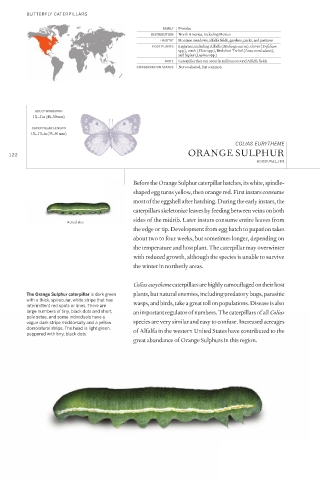
          The Orange Sulphur caterpillar is dark green   plants, but natural enemies, including predatory bugs, parasitic
          with a thick, spiracular, white stripe that has   wasps, and birds, take a great toll on populations. Disease is also
          intermittent red spots or lines. There are
          large numbers of tiny, black dots and short,   an important regulator of numbers. The caterpillars of all Colias
          pale setae, and some individuals have a
          vague dark stripe middorsally and a yellow   species are very similar and easy to confuse. Increased acreages
          dorsolateral stripe. The head is light green,   of Alfalfa in the western United States have contributed to the
          peppered with tiny, black dots.
                                            great abundance of Orange Sulphurs in this region.

