


Page 133 - The Book of Caterpillars: A Life-Size Guide to Six Hundred Species From Around the World
P. 133
BUTTERFLY CATERPILLARS
FAMILY Pieridae
DISTRIBUTION The Andes of Venezuela and Colombia, south to central Peru
HABITAT Cloud and upper subtropical forests and forest borders, often
along streams
HOST PLANTS Unknown species of mistletoe (Loranthaceae)
NOTE Plump, dull-colored caterpillar that feeds in very large groups
CONSERVATION STATUS Not evaluated, but not considered threatened
ADULT WINGSPAN
3¼–3⁄ in (82–88 mm)
CATERPILLAR LENGTH
2⅛–2⅜ in (55–60 mm)
PEREUTE CALLINICE
PEREUTE CALLINICE 131
(FELDER & FELDER, 1861)
Pereute callinice caterpillars hatch from elongate, yellow eggs,
laid in untidy clusters on the underside of leaves of their host
plant. The larvae are gregarious and, sometime during the fourth
or fifth instar, they begin to migrate daily, single file, down to the
base of the plant to which their own host is attached. They are,
then, most frequently found while resting in large groups during
the day on tree trunks, usually on alder species. It is not known,
however, if their host plant, mistletoe, is a specialist parasite on
alders. The caterpillar likely relies on its dull coloration and
sparse pale setae to camouflage it as a piece of moldy, dead leaf.
The butterfly adults are most frequently seen chasing each other
above the sunny canopy or, later in the day, found feeding on the
ground at puddles or water seeps. While at rest, with the bright
colors of the upper wing surfaces hidden, they are, like their
caterpillars, quite cryptic.
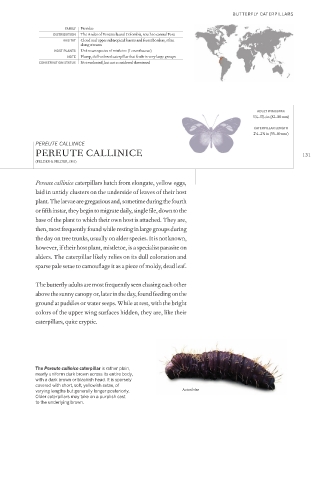
The Pereute callinice caterpillar is rather plain,
nearly uniform dark brown across its entire body,
with a dark brown or blackish head. It is sparsely
covered with short, soft, yellowish setae, of
varying lengths but generally longer posteriorly. Actual size
Older caterpillars may take on a purplish cast
to the underlying brown.

