


Page 123 - The Book of Caterpillars: A Life-Size Guide to Six Hundred Species From Around the World
P. 123
BUTTERFLY CATERPILLARS
FAMILY Pieridae
DISTRIBUTION India, Southeast Asia, southern China, Chinese Taipei,
and northern and eastern Australia
HABITAT Mainly subtropical and tropical in a variety of habitats;
adults often migrate to cooler temperate areas
HOST PLANTS Senna (Senna spp.) and cassia (Cassia spp.)
NOTE Colorful but well-camouflaged caterpillar of a
widespread butterfly
CONSERVATION STATUS Not evaluated, but common in some locations
ADULT WINGSPAN
2⁄ in (53 mm)
CATERPILLAR LENGTH
1⁄ in (37 mm)
CATOPSILIA PYRANTHE
MOTTLED EMIGRANT 121
(LINNAEUS, 1758)
Mottled Emigrant caterpillars feed openly on the leaves of
their host plants, usually on the upper surface of new or recent
growth, completing development in as little as four weeks under
warm conditions. Breeding may be continual throughout the
year but is often seasonal in many locations. The caterpillars
can be found in urban areas where the food plants are cultivated
as street trees or in gardens. Pupation occurs on a leaf or stem
of the food plant.
In Australia, Catopsilia pyranthe is also known as the White
Migrant, and, as suggested by the species’ common name, the
butterflies can be migratory. Pale and dark forms of the butterfly
can occur, depending on seasonal conditions. The genus
Catopsilia contains six species, ranging from Africa through
Southeast Asia to Australia. All are known to be migratory,
although migration may occur into areas where food plants are
absent and, as a result, no caterpillars will be found. Migratory
flights usually last only a few weeks.
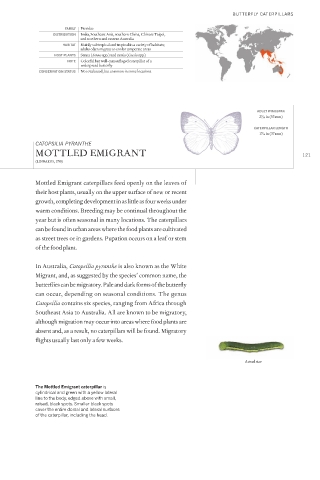
Actual size
The Mottled Emigrant caterpillar is
cylindrical and green with a yellow lateral
line to the body, edged above with small,
raised, black spots. Smaller black spots
cover the entire dorsal and lateral surfaces
of the caterpillar, including the head.

