


Page 134 - The Book of Caterpillars: A Life-Size Guide to Six Hundred Species From Around the World
P. 134
BUTTERFLY CATERPILLARS
FAMILY Pieridae
DISTRIBUTION Southeast Canada; northeastern, central, and southern
United States; south to South America
HABITAT Gardens, open spaces, disturbed areas, watercourses, glades,
and seashores
HOST PLANTS Senna (Senna spp., Cassia spp.), clover (Trifolium spp.),
and Chamaecrista spp.
NOTE Caterpillar camouflaged yellow or green, according
to its host plant
CONSERVATION STATUS Not evaluated, but common
ADULT WINGSPAN
2⁄–3⁄ in (65–78 mm)
CATERPILLAR LENGTH
1⁄–1¾ in (40–45 mm)
PHOEBIS SENNAE
CLOUDLESS SULPHUR
132
(LINNAEUS, 1758)
Cloudless Sulphur caterpillars hatch from eggs laid singly on
young leaves or flower buds of host plants six days earlier.
The larvae feed on foliage, buds, and flowers but do not build
shelters. The younger instars are not capable of diapause, so
those occurring in the more northerly areas are often killed
by freezing temperatures in fall. The caterpillars, which rest
beneath leaf petioles, rely on camouflage for protection from
natural enemies. If they eat mostly leaves, they are green, but
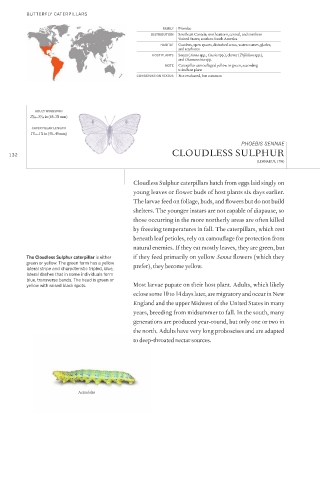
The Cloudless Sulphur caterpillar is either if they feed primarily on yellow Senna flowers (which they
green or yellow. The green form has a yellow prefer), they become yellow.
lateral stripe and characteristic tripled, blue,
lateral dashes that in some individuals form
blue, transverse bands. The head is green or
yellow with raised black spots. Most larvae pupate on their host plant. Adults, which likely
eclose some 10 to 14 days later, are migratory and occur in New
England and the upper Midwest of the United States in many
years, breeding from midsummer to fall. In the south, many
generations are produced year-round, but only one or two in
the north. Adults have very long proboscises and are adapted
to deep-throated nectar sources.
Actual size

