


Page 135 - The Book of Caterpillars: A Life-Size Guide to Six Hundred Species From Around the World
P. 135
BUTTERFLY CATERPILLARS

                      FAMILY  Pieridae
                  DISTRIBUTION  Europe, North Africa, South Africa, and Asia
                     HABITAT  Farms, vegetable gardens, croplands, and pastures
                  HOST PLANTS  Crucifers (Brassica spp.), including cabbage, caulifower,
                           and Brussels sprouts


                      NOTE  One of few agriculturally significant butterfly caterpillar pests
             CONSERVATION STATUS  Not evaluated, but widespread and common


                                                                                   ADULT WINGSPAN
                                                                                  2½–3 in (63–76 mm)
                                                                                  CATERPILLAR LENGTH
                                                                                  1³∕₈–1⁹∕₁₆ in (35–40 mm)
            PIERIS BRASSICAE
            LARGE WHITE                                                                          133

            (LINNAEUS, 1758)


            Large White caterpillars hatch from eggs laid in irregular
            batches of 30 to 100 on the underside of host plant leaves. They
            eat the empty shells, then spin a fine layer of silk over the leaf and

            feed gregariously, eating only the cuticle. Later they perforate
            the leaf. Large White caterpillars feed and rest at the same time.
            The caterpillars tend to congregate in a line along the edge of a
            leaf, devouring it as they move backward. Late instars disperse

            and feed singly. About 30 days after hatching, the final instar
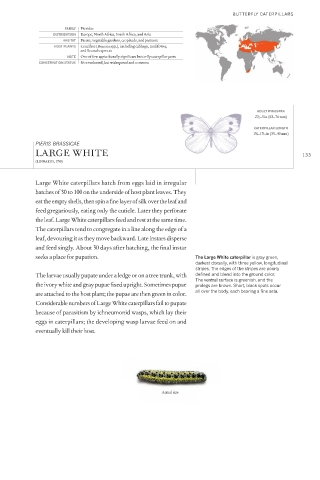
            seeks a place for pupation.                        The Large White caterpillar is gray green,
                                                               darkest dorsally, with three yellow, longitudinal
                                                               stripes. The edges of the stripes are poorly
            The larvae usually pupate under a ledge or on a tree trunk, with   de  ned and blend into the ground color.

            the ivory white and gray pupae fixed upright. Sometimes pupae   The ventral surface is greenish, and the
                                                               prolegs are brown. Short, black spots occur
            are attached to the host plant; the pupae are then green in color.   all over the body, each bearing a   ne seta.
            Considerable numbers of Large White caterpillars fail to pupate
            because of parasitism by ichneumonid wasps, which lay their
            eggs in caterpillars; the developing wasp larvae feed on and
            eventually kill their host.


                                                     Actual size

