


Page 275 - The Book of Caterpillars: A Life-Size Guide to Six Hundred Species From Around the World
P. 275
BUTTERFLY CATERPILLARS

                      FAMILY  Nymphalidae
                  DIS TRIBUTION  The Andes of Colombia, Ecuador, Peru, and Bolivia
                  DISTRIBUTION
                  DISTRIBUTION
                     HABITAT
                     HABITAT
                     HABIT A T  Landslides and second growth within Andean cloud forests
                  HOST PLANTS S  Bamboo (Chusquea spp.)
                    T PLANT
                  HOST PLANTS
                  HOS
                      NOTE
                        TE
                      NO
                      NOTE  Caterpillar that near-perfectly mimics dead bamboo leaves
                       A
             CONSERVATION STATUS
                   TION S
                  A
                      T
                       TUS
             CONSERVATION STATUS  Not evaluated, but not considered threatened
             CONSERV
                                                                                   ADULT WINGSPAN
                                                                                  2¾–3 in (70–75 mm)
                                                                                  CATERPILLAR LENGTH
                                                                                 2 ⁄  –2  ⁄   in (62–68 mm)
            PRONOPHILA ORCUS
            ORCUS GREAT-SATYR                                                                    273
            (LATREILLE, 1813)
            Orcus Great-satyr caterpillars hatch from white, spherical eggs,

            laid in clusters of two to  ve on the underside of fresh host plant
            leaves. The larvae, however, are not gregarious and quickly
            disperse to their own leaves. Their complex patterning of shades
            of brown, along with their elongate, tapering shape, make them
            extremely cryptic on their host plant. They are nearly identical
            in shape and color to a dead bamboo leaf, and even the white
            spots on the thorax are part of this mimicry, being very similar
            to a type of white fungus that frequently attacks dead leaves.
            The pupa, hung from the underside of a cluster of dead bamboo
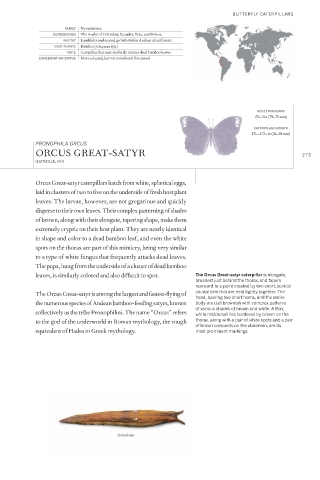
            leaves, is similarly colored and also di cult to spot.    The Orcus Great-satyr caterpillar is elongate,


                                                               broadest just behind the thorax, and tapers
                                                               rearward to a point created by two short, conical
            The Orcus Great-satyr is among the largest and fastest- ying of   caudal tails that are held tightly together. The

                                                               head, bearing two short horns, and the entire
            the numerous species of Andean bamboo-feeding satyrs, known   body are dull brownish with complex patterns
            collectively as the tribe Pronophilini. The name “Orcus” refers   of various shades of brown and white. A thin,
                                                               white middorsal line bordered by brown on the
            to the god of the underworld in Roman mythology, the rough   thorax, along with a pair of white spots and a pair
                                                               of brown crescents on the abdomen, are its
            equivalent of Hades in Greek mythology.            most prominent markings.


                                      Actual size

