


Page 271 - The Book of Caterpillars: A Life-Size Guide to Six Hundred Species From Around the World
P. 271
BUTTERFLY CATERPILLARS

                      FAMILY  Nymphalidae
                  DISTRIBUTION  North Africa, Europe, central Asia, Siberia, northern India,
                           eastern China, and Japan
                     HABITAT  Woodlands, especially glades, rides, and margins; also hedgerows
                           and gardens
                  HOST PLANTS  Various, including nettle (Urtica spp.), currants (Ribes spp.),
                           and sometimes willow (Salix spp.)
                      NOTE  Caterpillar that looks like a bird dropping in later instars
             CONSERVATION STATUS  Not evaluated, but common and increasingly widespread


                                                                                   ADULT WINGSPAN
                                                                                  1⅝–1⅞ in (42–47 mm)
                                                                                  CATERPILLAR LENGTH


                                                                                    1⅜ in (35 mm)
            POLYGONIA C-ALBUM
            COMMA                                                                                269
            (LINNAEUS, 1758)


            Comma caterpillars hatch from eggs laid singly, near the edge
            of the upper surface of leaves. Over the two or three weeks
            before they hatch, the eggs turn from green to yellow to gray.
            The newly emerged larvae move to the underside of the leaf,
            where they start feeding, and then the older caterpillars move
            back to the upper surface, protected to some extent by their     Actual size
            bird-dropping appearance. The caterpillars pupate on the host
            plant or nearby vegetation, suspended beneath a twig or stem;
            the pupae darken to resemble withered leaves.


            The adults, which eclose within three weeks, can be seen almost
            any time of year as overwintering adults may become active on

            warm winter days. The  rst generation appears in early summer,
            while in late summer there is a second generation of adults much
            darker in color. In the southernmost part of the Comma’s range,
            there may be a third generation. This is one of the few species
            that has an expanding range as a result of a warming climate.


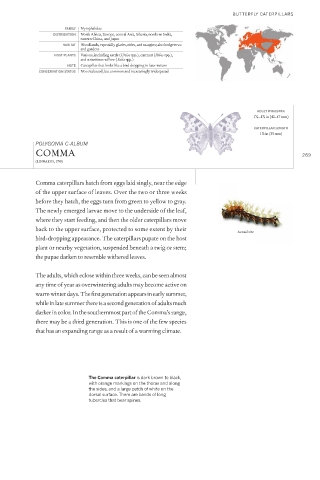
                             The Comma caterpillar is dark brown to black,
                             with orange markings on the thorax and along
                             the sides, and a large patch of white on the
                             dorsal surface. There are bands of long
                             tubercles that bear spines.

