


Page 279 - The Book of Caterpillars: A Life-Size Guide to Six Hundred Species From Around the World
P. 279
BUTTERFLY CATERPILLARS

                      FAMILY  Nymphalidae
                  DISTRIBUTION  From southern United States through the Caribbean and
                           Central America to the Amazon basin
                     HABITAT  Humid, semi-humid, and deciduous forests, both tropical
                           and subtemperate
                  HOST PLANTS  Mostly Blechum spp., Justicia spp., and Ruellia spp.; also
                           Calliandra spp., Salvia spp., and Plantago spp.
                      NOTE  Sluggish, inconspicuous caterpillar that is hidden on
                           ground-cover plants
             CONSERVATION STATUS  Not evaluated, but unlikely to be endangered


                                                                                   ADULT WINGSPAN
                                                                                  2–2⅜ in (50–60 mm)
                                                                                  CATERPILLAR LENGTH
                                                                                  2–2⅛ in (50–55 mm)
            SIPROETA STELENES
            MALACHITE                                                                            277

            (LINNAEUS, 1758)


            Malachite larvae of all ages are somewhat sluggish and reluctant
            to move, even when prodded. They generally stay hidden on the
            underside of host plant leaves and, despite their relatively bright
            coloration, can be di cult to  nd, especially when feeding on


            low-growing, densely leaved succulents. Given the Malachite’s
            very large geographic range, it is not surprising that the species
            is found in so many habitats, and that its caterpillars are known
            to feed on so many types of plants.


            The adults are nimble, wary flyers, often seen perching on
            the upper surface of leaves, wings partially open, some 3–6	ft
            (1–2	m) above the ground. They are quickly distinguished
            from the very similar, but much longer-winged, Scarce Bamboo
            Page (Philaethria dido) by the irregular-shaped margins of both
            wings. In many areas where the species inhabits fairly seasonal
            forests, local or regional migrations are suspected, but these are
            poorly documented.
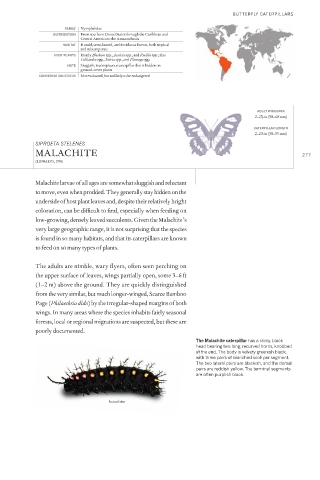
                                                                The Malachite caterpillar has a shiny, black
                                                                head bearing two long, recurved horns, knobbed
                                                                at the end. The body is velvety greenish black,
                                                                with three pairs of branched scoli per segment.
                                                                The two lateral pairs are blackish, and the dorsal
                                                                pairs are reddish yellow. The terminal segments
                                                                are often purplish black.


                                    Actual size

