


Page 276 - The Book of Caterpillars: A Life-Size Guide to Six Hundred Species From Around the World
P. 276
BUTTERFLY CATERPILLARS

                                                     FAMILY  Nymphalidae
                                                 DISTRIBUTION  Northwest Himalayas through to central China, Thailand,
                                                          and northern Vietnam
                                                    HABITAT  Hill forests and streams
                                                  HOST PLANTS  Debregeasia spp.
                                                      NOTE  Horned, green caterpillar that blends seamlessly with its
                                                          food plant
                                             CONSERVATION STATUS  Not evaluated, but less common in its Himalayan range,
                                                          although not threatened


            ADULT WINGSPAN
           2–2⅛ in (50–55 mm)
           CATERPILLAR LENGTH
             1¾ in (45 mm)
                                                                          PSEUDERGOLIS WEDAH
                                                                                 TABBY
    274
                                                                                    (KOLLAR, 1844)


                                            The early instar Tabby caterpillar constructs a resting perch
                                            from the lateral leaf margins, protected by a wall of silk-bound
                                            frass. By the third instar, the caterpillar starts to develop the
                                            horns that are so prominent in later instars. As the larvae mature,
                                            they also take on the color and texture of the deeply corrugated
                                            and hairy leaves, progressing from the green of fresh young
                                            foliage to the yellower dappled appearance of older leaves,
                                            which renders them almost invisible when at rest. The caterpillar
                                            more than doubles in length from the fourth to the  fth ( nal)


                                            instar, at which time it rests  at against the leaf upper surface

                                            on a bed of silk.

                                            The Tabby’s chrysalis is also very cryptic and has a broad keel
                                            that curves downward from the thorax to meet another upwardly
                                            curved protuberance from the abdomen. The genus Pseudergolis
                                            includes only two species of butter y. They are sun-baskers,

                                            particularly near water, and can be very territorial.


                                  Actual size
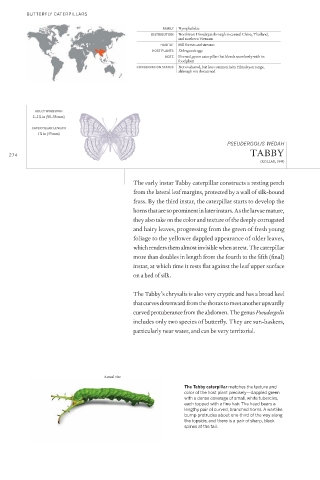
                                                            The Tabby caterpillar matches the texture and
                                                            color of the host plant precisely—dappled green
                                                            with a dense coverage of small, white tubercles,
                                                            each topped with a   ne hair. The head bears a
                                                            lengthy pair of curved, branched horns. A wartlike
                                                            bump protrudes about one-third of the way along
                                                            the topside, and there is a pair of sharp, black
                                                            spines at the tail.

