


Page 274 - The Book of Caterpillars: A Life-Size Guide to Six Hundred Species From Around the World
P. 274
BUTTERFLY CATERPILLARS

                                                     FAMILY  Nymphalidae
                                                 DISTRIBUTION  Nepal, northern India, central and southern China, Japan,
                                                          Chinese Taipei, and mainland Southeast Asia
                                                    HABITAT  Elevated evergreen forests
                                                  HOST PLANTS  Rhamnella franguloides, Celtis boninensis, and Albizia spp.
                                                      NOTE  “Dragonhead” caterpillar that has an impressive set of horns
                                             CONSERVATION STATUS  Not evaluated, but not uncommon, although some subspecies are
                                                          geographically isolated


            ADULT WINGSPAN
           3½–4⅝ in (90–120 mm)
           CATERPILLAR LENGTH
             2⅜ in (60 mm)
                                                                          POLYURA EUDAMIPPUS
                                                                    GREAT NAWAB
    272
                                                                                  (DOUBLEDAY, 1843)


                                            By the time the Great Nawab caterpillar has devoured its
                                            own eggshell at hatching, its full set of horns has inflated
                                            and hardened. This is a characteristic of the Charaxinae
                                            “dragonhead” caterpillars not shared by related subfamilies
                                            of horned larvae, which develop horns only by the mid-instar
                                            stages. The caterpillars build a silk pad on a leaf tip, expanding
                                            on this “base camp” for their entire cycle and wandering away
                                            at night to feed on adjoining foliage. During the day, they make
                                            no attempt to conceal themselves but remain stationary and
                                            exposed, often with the anterior half of the body raised. Pupation
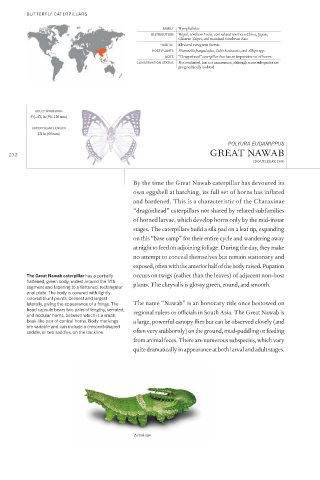
          The Great Nawab caterpillar has a partially   occurs on twigs (rather than the leaves) of adjacent non-host
            attened, green body, widest around the   fth   plants. The chrysalis is glossy green, round, and smooth.
          segment and tapering to a   attened, rectangular
          anal plate. The body is covered with lightly
          colored blunt points, densest and largest
          laterally, giving the appearance of a fringe. The   The name “Nawab” is an honorary title once bestowed on
          head capsule bears two pairs of lengthy, serrated,   regional rulers or o cials in South Asia. The Great Nawab is


          and nodular horns, between which is a small,

          beak-like pair of conical horns. Body markings   a large, powerful canopy  ier but can be observed closely (and
          are variable and can include a crescent-shaped
          saddle, or two saddles, on the backline.  often very stubbornly) on the ground, mud-puddling or feeding
                                            from animal feces. There are numerous subspecies, which vary
                                            quite dramatically in appearance at both larval and adult stages.


                                            Actual size

