


Page 278 - The Book of Caterpillars: A Life-Size Guide to Six Hundred Species From Around the World
P. 278
BUTTERFLY CATERPILLARS

                                                     FAMILY  Nymphalidae
                                                 DISTRIBUTION  From Mexico through Central America and northern
                                                          South America, south as far as Bolivia
                                                    HABITAT  Lowland humid forests
                                                  HOST PLANTS  Serjania spp.

                                                      NOTE  Newly described caterpillar that has a lea ike pupa
                                             CONSERVATION STATUS  Not evaluated, but not likely to be endangered


            ADULT WINGSPAN
           2⅛–2 ⁄   in (55–65 mm)
           CATERPILLAR LENGTH
           1
⁄  –1 ⁄   in (33–37 mm)
                                                                          PYRRHOGYRA OTOLAIS
                                                DOUBLE-BANDED BANNER
    276
                                                                                      BATES, 1864


                                            Double-banded Banner larvae hatch from eggs laid singly on the
                                            bright red, newly expanding leaves of their host plants. Young
                                            caterpillars rest near the ends of frass chains, while larger instars
                                            rest on top of the host leaf, with their face pressed tightly to
                                            the leaf surface. When disturbed, older larvae rear backward
                                            to thrash wildly about with their long scoli, often lifting their
                                            terminal abdominal segments simultaneously, bringing these
                                            scoli to bear as well. Their lea  ike, emerald-green pupae are
                                            somewhat oddly attached, being affixed by the cremaster to
                                            the dorsal surface of the leaf and standing upright, overall
                                            resembling a piece of green leaf that has curled upward.


                                            Despite the Double-banded Banner’s wide geographic
                                            distribution, and its formal recognition as a species more than a
                                            century and a half ago, its larval stages and host plant preferences
                                            were described only at the beginning of this century. The

                                            adults are very fast  iers and feed on fallen fruit, rotting fungi,
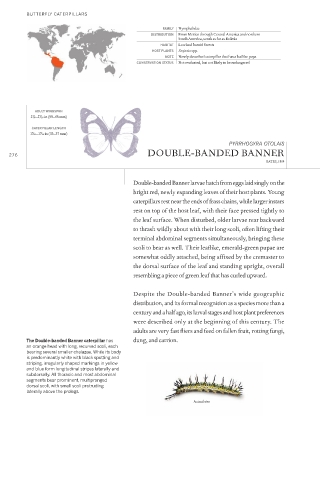
         The Double-banded Banner caterpillar has   dung, and carrion.
         an orange head with long, recurved scoli, each
         bearing several smaller chalazae. While its body
         is predominantly white with black spotting and
         striping, irregularly shaped markings in yellow
         and blue form longitudinal stripes laterally and
         subdorsally. All thoracic and most abdominal
         segments bear prominent, multipronged
         dorsal scoli, with small scoli protruding
         laterally above the prolegs.
                                                               Actual size

