


Page 272 - The Book of Caterpillars: A Life-Size Guide to Six Hundred Species From Around the World
P. 272
BUTTERFLY CATERPILLARS

                                                     FAMILY  Nymphalidae
                                                 DISTRIBUTION  Western North America, from Alaska to New Mexico
                                                    HABITAT  Mountain areas above 3,300 ft (1,000 m) elevation, including
                                                          meadows, streams, roads, and trails
                                                  HOST PLANTS  Currant (Ribes spp.) and elm (Ulnus spp.)
                                                      NOTE  Caterpillar protected by spines and often by spiny host plants
                                             CONSERVATION STATUS  Not evaluated, but common


            ADULT WINGSPAN
           1¾–2 in (45–50 mm)
           CATERPILLAR LENGTH


           1⅜–1½ in (35–38 mm)
                                                                           POLYGONIA GRACILIS
                                                                  HOARY COMMA
    270
                                                                              (GROTE & ROBINSON, 1867)


                                            Hoary Comma caterpillars hatch from eggs laid singly, or in
                                            groups of three or four, on the underside of host plant leaves
                                            four or five days earlier. Feeding from the leaf edges, they
                                            create jagged holes. The caterpillars rest on stems or leaves of
                                            the host, usually on the undersides, where they are hidden from

                                            aerial predators. Concealment and camou age a ord the larvae

                                            some protection, as do the spines of some of their host plants.
                                            Chemicals emitted from a small ventral gland near the head may
                                            also repel some attackers. Shelters are not constructed. In later
                                            instars, caterpillars disperse, with only one or two per shrub.


                                            The caterpillars go through  ve instars, each taking about  ve


                                            days to complete, and pupation occurs on or near the host plant;
                                            the pupal period lasts about nine days. The butter y adults are

                                            long-lived (up to 12 months), and there is only one generation

                                            a year. The  ight period extends from mid-March to October,
                                            and adults overwinter.


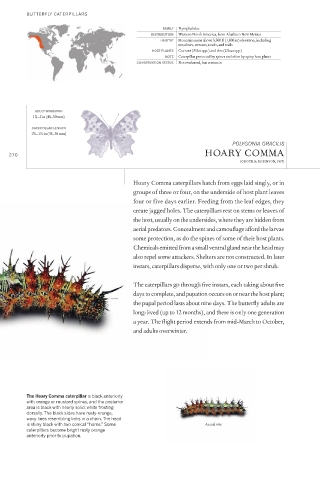
          The Hoary Comma caterpillar is black anteriorly
          with orange or mustard spines, and the posterior
          area is black with nearly solid, white frosting
          dorsally. The black sides have rusty-orange,
          wavy lines resembling links in a chain. The head
          is shiny black with two conical “horns.” Some           Actual size
          caterpillars become bright rusty orange
          anteriorly prior to pupation.

