


Page 282 - The Book of Caterpillars: A Life-Size Guide to Six Hundred Species From Around the World
P. 282
BUTTERFLY CATERPILLARS

                                                     FAMILY  Nymphalidae
                                                 DISTRIBUTION  North America, Europe, and much of Asia
                                                    HABITAT  Many habitats, including parks, gardens, woodlands, meadows,
                                                          orchards, and riparian areas
                                                  HOST PLANTS  Nettle (Urtica spp.), pellitory (Parietaria spp.), and
                                                          hop (Humulus spp.)
                                                      NOTE  Variably colored, nettle-feeding, spiny caterpillar
                                             CONSERVATION STATUS  Not evaluated, but common


            ADULT WINGSPAN
           2–2⅛ in (50–55 mm)
           CATERPILLAR LENGTH
           1 ⁄  –1⅜ in (30–35 mm)


                                                                            VANESSA ATALANTA
                                                                     RED ADMIRAL
    280
                                                                                   (LINNAEUS, 1758)


                                            Red Admiral caterpillars hatch from eggs laid singly on the
                                            underside of nettle leaves, typically on a leaf vein. Early instars
                                            rasp leaf surfaces with their mandibles, creating holes, and
                                            produce small amounts of silk to cover themselves, forming
                                            loosely silked nests. Later instars form shelters by folding a leaf
                                            over or silking a group of leaves together. Feeding occurs inside
                                            or outside nests at any time of day or night. Defense is based
                                            mainly on concealment within nests, but the caterpillars also
                        Actual size
                                            possess a ventral gland near the head that likely secretes chemicals
                                            to deter predators.


                                            The caterpillars go through  ve instars and pupate about three

                                            weeks after hatching, usually on the host plant. The Red Admiral
                                            adult, a familiar sight in home gardens, is one of the northern

                                            hemisphere’s best known and most charismatic butter ies. If the
                                            garden also has a nettle patch, then Red Admiral caterpillars are
                                            likely to be found there.


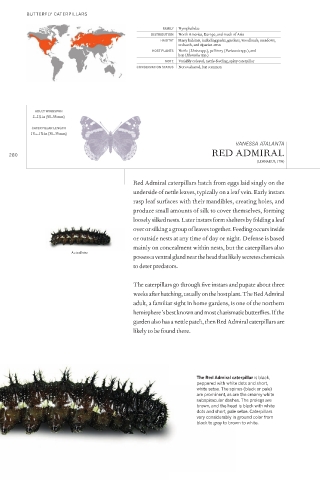
                                                                The Red Admiral caterpillar is black,
                                                                peppered with white dots and short,
                                                                white setae. The spines (black or pale)
                                                                are prominent, as are the creamy white
                                                                subspiracular dashes. The prolegs are
                                                                brown, and the head is black with white
                                                                dots and short, pale setae. Caterpillars
                                                                vary considerably in ground color from
                                                                black to gray to brown to white.

