


Page 281 - The Book of Caterpillars: A Life-Size Guide to Six Hundred Species From Around the World
P. 281
BUTTERFLY CATERPILLARS

                      FAMILY  Nymphalidae
                  DISTRIBUTION  Indonesia, the Philippines, New Guinea, and northern and
                           eastern Australia
                     HABITAT  Monsoon vine thickets and littoral rain forests
                  HOST PLANTS  Usually Corky Milk Vine (Secamone elliptica); also other
                           Apocynaceae spp.
                      NOTE  Colorful caterpillar that can defoliate its host plant vine
             CONSERVATION STATUS  Not evaluated, but common near breeding areas


                                                                                   ADULT WINGSPAN
                                                                                   2  ⁄   in (72 mm)
                                                                                  CATERPILLAR LENGTH
                                                                                    2 in (50 mm)
            TIRUMALA HAMATA
            BLUE TIGER                                                                           279

            (W. S. MACLEAY, 1826)


            The Blue Tiger caterpillar is generally solitary on the food plant,
            but it is a voracious feeder, and when populations are high, large
            numbers of larvae can strip milk vines of all foliage. Caterpillars
            feed exposed on the plants, developing rapidly to complete their
            growth in two weeks or less. The larvae accumulate chemicals
            that provide protection from bird predation and also enable them
            to produce pheromones, which are released from the hair pencil
            tufted pheromone signaling organs of the male butter ies.


            Caterpillars will often leave the food plant and pupate on nearby
            foliage, suspended head down by the cremaster. During the
            dry season of winter, the milk vines have no fresh foliage and
            are unsuitable for caterpillar development. Adult butter  ies
            congregate in shady creek banks to overwinter, often with other
            species of milkweed butter ies, and then disperse in the spring

            to commence reproduction. Large migration  ights often occur

            during the breeding season.


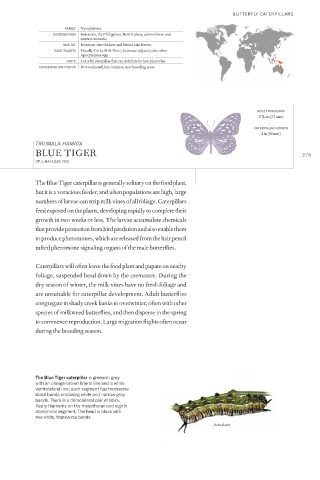
            The Blue Tiger caterpillar is greenish gray
            with an orange-brown lateral line and a white
            ventrolateral line; each segment has transverse
            black bands enclosing white and narrow gray
            bands. There is a dorsolateral pair of black,
              eshy   laments on the mesothorax and eighth
            abdominal segment. The head is black with
            two white, transverse bands.
                                                                     Actual size

