


Page 297 - The Book of Caterpillars: A Life-Size Guide to Six Hundred Species From Around the World
P. 297
MOTH CATERPILLARS

                      FAMILY  Castniidae
                  DISTRIBUTION  Southeastern Australia
                     HABITAT  Native grasslands
                  HOST PLANTS  Wallaby grasses (Rytidosperma spp.), spear grasses (Austrostipa
                           spp.), and Chilean Needle Grass (Nassella neesiana)
                      NOTE  Subterranean caterpillar that feeds on grass roots
             CONSERVATION STATUS  Not evaluated, but listed as critically endangered under
                           Commonwealth of Australia legislation


                                                                                   ADULT WINGSPAN
                                                                                  1¼–1
⁄   in (31–34 mm)
                                                                                  CATERPILLAR LENGTH
                                                                                    1⅛ in (28 mm)
            SYNEMON PLANA
            GOLDEN SUN MOTH                                                                      295

            WALKER, 1854


            The Golden Sun Moth caterpillar hatches from an egg laid
            at the base of a grass clump. A female may lay up to 200 eggs over
            many clumps. The caterpillar tunnels underground, where it
            remains feeding on grass roots for up to two years, although the
            details of the development of caterpillars is not well documented.
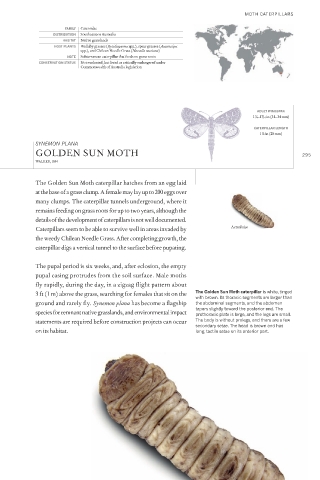
            Caterpillars seem to be able to survive well in areas invaded by   Actual size
            the weedy Chilean Needle Grass. After completing growth, the
            caterpillar digs a vertical tunnel to the surface before pupating.


            The pupal period is six weeks, and, after eclosion, the empty
            pupal casing protrudes from the soil surface. Male moths
            fly rapidly, during the day, in a zigzag flight pattern about
            3 ft (1 m) above the grass, searching for females that sit on the   The Golden Sun Moth caterpillar is white, tinged
                                                               with brown. Its thoracic segments are larger than
            ground and rarely fly. Synemon plana has become a flagship   the abdominal segments, and the abdomen
            species for remnant native grasslands, and environmental impact   tapers slightly toward the posterior end. The
                                                               prothoracic plate is large, and the legs are small.
            statements are required before construction projects can occur   The body is without prolegs, and there are a few
            on its habitat.                                    secondary setae. The head is brown and has
                                                               long, tactile setae on its anterior part.

