


Page 296 - The Book of Caterpillars: A Life-Size Guide to Six Hundred Species From Around the World
P. 296
MOTH CATERPILLARS

                                                     FAMILY  Cossidae
                                                 DISTRIBUTION  Europe, the Middle East, central Asia, Russia, and China
                                                    HABITAT  Woodlands, parks, and gardens
                                                  HOST PLANTS  Deciduous trees such as oak (Quercus spp.), ash (Fraxinus spp.),
                                                          and apple (Malus spp.)
                                                      NOTE  Wood-eating and tunneling caterpillar that is rarely seen
                                             CONSERVATION STATUS  Not evaluated, but widespread though declining in parts
                                                          of its range


            ADULT WINGSPAN
           2     –3¾ in (68–96mm)
           CATERPILLAR LENGTH
             4 in (100 mm)
                                                                               COSSUS COSSUS
                                                                       GOAT MOTH
    294
                                                                                   (LINNAEUS, 1758)


                                            The young Goat Moth caterpillar, named for the peculiar,
                                            strong, goatlike odor it gives o , burrows into the trunk of the

                                            host tree and gnaws out a chamber in which to overwinter. Wood


                                            is di cult to digest, so the caterpillar grows slowly and may
                                            spend up to  ve years in the larval stage. Eventually, it abandons

                                            the tree and moves to the ground or an old tree stump, where it
                                            spins a silk cocoon and pupates, incorporating particles of soil
                                            to disguise the cocoon. In more northerly areas, the caterpillar
                                            pupates inside the tree.


                                            The large, grayish-brown adult emerges and   ies between
                                            April, in more southerly locations, and August, in the north
                                            of its range. The caterpillar is unusual for its habit of feeding
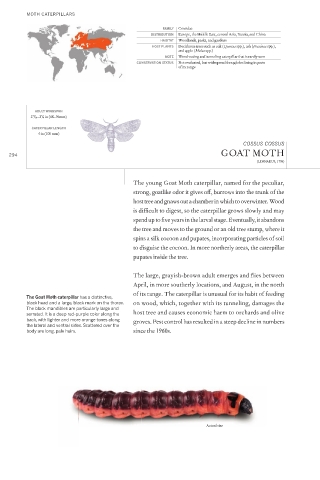
         The Goat Moth caterpillar has a distinctive,
         black head and a large, black mark on the thorax.   on wood, which, together with its tunneling, damages the
         The black mandibles are particularly large and
         serrated. It is a deep red-purple color along the   host tree and causes economic harm to orchards and olive
         back, with lighter and more orange tones along   groves. Pest control has resulted in a steep decline in numbers
         the lateral and ventral sides. Scattered over the
         body are long, pale hairs.         since the 1960s.


                                                                   Actual size

